Tie-off or not?
20 March 2008
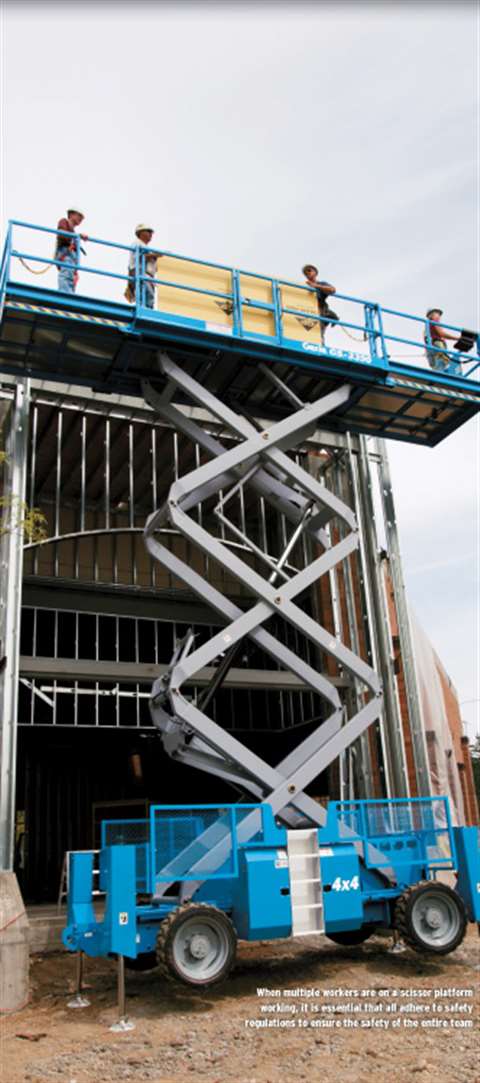
Those in the industry might think it would be easy for everyone to agree on whether a scissor operator should wear a harness. Unfortunately, the issue is not that simple.
The appropriate OSHA regulations for scissors (which are actually contained in the Subpart L Scaffold section of regulation 1926.451 (g)) require that workers raised above 10 feet have to be protected by a restraint system, fall arrest system or guardrail. Tying off is not required where there are guardrails, as on a scissor lift.
Similarly, the ANSI standard that covers scissor lifts – A92.6–1999 – does not require the use of a harness because the primary fall protection is the midrail and guardrail.
However, in practice, some major manufacturers and rental companies – JLG Industries and Sunbelt Rentals being the two most prominent – do require the use of harnesses in scissors. Others, meanwhile, think there should be a case by case approach, with a risk assessment taken before making a decision.
It is a debate that has recently been in focus because the International Powered Access Federation (IPAF) has launched a worldwide campaign to encourage the use of harnesses in boom–type platforms. Its recommendation in Europe and most of the world, however, is that harnesses are not required when operating a scissor lift.
However, IPAF's US subsidiary, AWPT, is providing slightly different advice for the US. Its recommendation for boom type platforms is the same – and is widely supported. But for scissor lifts, after saying that “it is not normally necessary” to wear a harness, it adds the caveat “except when the manufacturer recommends the use of, or requires the use of, personal fall protection equipment.”
This qualification to its US advice follows inevitably from the different positions taken in the matter by North American aerial manufacturers.
First of all, let's rehearse the arguments against wearing a harness in a scissor lift. Some suggest that the use of a harness and lanyard on a scissor can actually increase the risk of an accident. There are several elements to this argument:
A harness presents a false sense of security, especially for untrained users;
It inhibits maneuverability and mobility of occupants;
When more than one worker is on the platform, lanyards can be tangled or cause tripping hazards;
The lack of mobility on the platform can restrict the operator from seeing all points around the platform when driving.
The AWPT's Membership Development Director Tony Groat says first and foremost, a risk assessment should be taken before the use of a harness and lanyard system.
“I will begin with the position that the use of harness and lanyards began to mitigate the risk on boom type lifts from the risk of catapult effect on operators,” says Groat. “This risk does not exist with scissor lifts.” He says there are exceptions for use of a harness and lanyard on a boom lift, such as when working over water, but believes a harness should not be used on a scissor type lift.
“As a standard for operation, I would say that I would likely not endorse the use of a harness and lanyard on a scissor type lift,” says Groat.
The fact that manufacturers have anchorage points on most aerial lifts, including scissor lifts, despite that fact that some do not require their use on scissor lifts, speaks to the issue of site specific needs. “As a risk assessment, here are some potential issues: The size of a platform for a scissor lift can be exceptionally larger than that of a boom type lift,” he says. “If you have a large platform, normally a higher capacity, there are two or more individuals operating off this platform and they have on these long lanyards that are crossing one another. [This presents] a tripping or tangling hazard or they become restricted and cannot move. Otherwise they will have a short lanyard that will restrict movement and the use of the platform.”
Snorkel states the only time a harness is required on a scissor is when a particular site requires it or if there are specific local regulations.
Another example he cites is if a worker is tied off and the lift has a relatively narrow platform with a horizontal side load that is very low (some machines can go as low as 100 pounds capacity) and if he reaches over the guardrail too far, his own weight could tip the machine over. And because that operator is tied off, he could literally go out of the lift and have the machine fall on top of him.
Ultimately, the AWPT would like there to be a uniform standard that the whole industry can abide to. At this time, no state has a specific requirement beyond the ANSI/OSHA regulations regarding the use of a harness and lanyard. Groat says it is within the realm of possibilities that a state mandate its own unique regulations on harness use, especially if perception grows that use with scissor lifts is appropriate.
“The desire is to define what the industry standard is that will best protect the operator of aerial platforms,” says Groat.
So what do the manufacturers think? Skyjack's Director of Product Safety Brad Boehler is in agreement with AWPT. “Ultimately, our position is defined by what the standards state and on scissor lifts there is no requirement to wear a harness, as the guardrail is the primary fall protection system.”
He does recognize that some rental yards and end users require the use of harness and lanyard. In that case, Skyjack recommends a fall restraint harness rather than a fall arrest system.
What about JLG and Genie? JLG was at least very clear, its spokesperson telling ALH that it requires the use of a full body harness and lanyard at all times, including for scissors. When asked if there were ever exceptions, the company says regardless, a harness and full body harness must be worn at all times. It would be fair to say that JLG wasn't too keen on having an expansive discussion on its position.
The sensitivity of the issue was highlighted when Genie told ALH that it was unable to provide a response to the question of wearing a harness in a scissor in time for inclusion for the article. We hope to report on Genie's views in our next edition.
Snorkel's position is that it follows OSHA requirements. Richard Hoffelmeyer, vice president of engineering, says the only time a harness is required on a scissor is when a particular site requires it or if there are specific local regulations.
Meanwhile, the “Fall Protection Notice” issued by MEC Aerial Platforms in California says that the platform guardrail system on its scissor lifts satisfies the fall protection mandate set by ANSI A92.6–1999.
The document reads that if anchorage points for lanyard attachments are required by site authorities or other regulations, they should be used for work positioning restraint only within the platform.
“With my product I recommend not having safety harnesses on,” says Steve Kissinger, president and CEO of Custom Equipment. “I think they restrict you. With a fully enclosed cage, I feel the operators are safe.”
Kissinger is all in favor of a uniform standard. He says there are a lot of differences in the ANSI, CE, and other regulations and that it would be a benefit to all the manufacturers if the standards were uniform. The company is in the process right now of creating its own safety program.
Rental yards are divided, as well. Sunbelt Rental's National Safety Director Jeff Stachowiak says it is company policy to wear a harness and lanyard with a scissor. “We require all Sunbelt Team Members to use a full body harness and shock absorbing lanyard attached to the manufacturer anchorage point at all times when operating an aerial work platform, including scissor lifts and push–around personnel lifts.”
He says Sunbelt as a company feels that hooking to the anchorage point and the use of personal fall protection outweighs other hazards related to the harness and lanyard.
St. Louis's Midwest Aerial & Equipment on the other hand follows OSHA and does not require a harness and lanyard. According to its Safety Director Gary Riley, the guardrails offer fall protection and having the worker's feet firmly cemented in the platform ensure stability.
However, he also requires risk assessment before each job. He feels, like AWPT's Groat, that a harness and lanyard oftentimes will give a false sense of security to the uneducated operator.
He “whole–heartedly” supports the AWPT training and is in the process of becoming an approved center through the program.
Custom Equipment says it would be a benefit to all the manufacturers if the standards were uniform.
“There are only a few ways to fall over the top of a properly maintained 42–inch guardrail, and a scissor lift ejection is not one of them,” says Riley. “If the operator is wearing fall arrest and is willing to take the unmanaged risk of gaining additional height the real question is, ‘What if he falls?’ If you want to truly help manage these fall hazards, educate your employees with a qualified instructor – do not train them with a 15 minute video.” Midwest's training program hammers home the primary causes of serious accidents: platform stability, electrical risks, smash points, and more.
It is clear that everybody – manufacturers, rental companies and others – shares the same concerns about worker safety. But when it comes to the issue of wearing harnesses in scissors, would the cause of worker safety not be better served if everyone could agree publicly on what was best?
STAY CONNECTED



Receive the information you need when you need it through our world-leading magazines, newsletters and daily briefings.


CONNECT WITH THE TEAM