



Read this article in 中文 Français Deutsch Italiano Português Español
Better tire decisions start at the jobsite
Partner Content produced by KHL Content Studio
18 November 2026
Tech Wang, founder and chairman of Techking Tires on the importance of tire technology to machine performance.
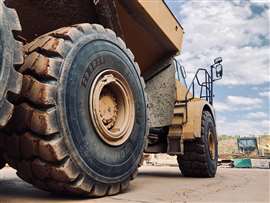 Is enough consideration being given to the point of contact between off-road equipment and the earth beneath them?
--------
Early in my career, I could see that technology creates most value when it solves customers’ problems.
That belief has shaped the approach of Techking. For construction and mining operators, a tire has to contribute to the performance of the whole operation.
Its value depends on how reliably and efficiently it supports the work.
This is why I often tell our team that the answer is in the field. Before recommending a tire, we need to understand what the customer is asking the tire to do.
Look beyond the machine model
Two identical trucks can face very different challenges. At an iron ore mine in Australia’s Pilbara region, heat may be the main concern.
At a high-altitude copper mine in Chile, sharp rock may make cuts and chipping the greater threat.
The truck model and tire size are the same, but the tire characteristics required can differ substantially.
When assessing an application, we pay particular attention to ground conditions, payload, temperature, haul distance and operating speed.
Together, these determine the balance needed between grip, load capacity, resistance to damage and heat management.
For a fleet manager, the practical starting point is to explain the operation in detail.
What material is being carried? How far does the machine travel? Where does damage occur?
Those answers help us move from a broad product recommendation to a specification that reflects the job.
Understand the cost of a mismatch
 Tech Wang, founder and chairman of Techking Tires
Purchase price is visible and easy to compare, but the consequences of a poor application match often become apparent later.
Irregular wear, chunking and premature damage can shorten tire life. Rolling resistance can influence fuel or electricity consumption. A tire-related stoppage also takes a productive machine out of service.
In a continuously operating mine, that disruption can cost considerably more than the replacement tire itself.
I believe total cost of ownership should therefore guide the decision. We need to consider service life, energy use, maintenance and downtime together.
This also means being realistic about engineering trade-offs. Greater durability and lower rolling resistance needs to be balanced against the demands of the application.
The useful question is which combination will deliver the best result under the customer’s actual operating conditions.
Turn site experience into better engineering
One example of this approach began when our engineers saw operators in Canada cutting additional grooves into snow tires by hand.
They needed more grip while retaining protection against stones.
We subsequently identified a similar requirement in northern Europe and worked with a Norwegian customer on a solution.
Inspired by polar bear paws, our engineers developed the zigzag tread pattern we named SNOWKING, improving grip while maintaining strong tread blocks.
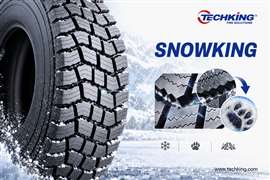 Inspired by polar bear paws, SNOWKING’s biomimetic tread design enhances grip and traction
For me, the important point is how the development started: operators had identified a problem through their daily work.
Our engineers gather that knowledge by observing sites, speaking with operators and maintenance teams, and inspecting tires both in service and after removal.
We then translate those observations into engineering parameters, including load distribution, heat generation and contact stress.
An existing product may meet the requirement, but when it doesn’t, that evidence should inform new development.
Keep learning after installation
Fitting the tire is only one stage of the process. Inflation pressure, inspections and rotation continue to influence performance throughout its working life.
Our local technical and service teams help customers manage these factors while collecting evidence about how tires perform.
For me, field service is a basic element of research and development.
When engineers investigate damage and compare it with simulation predictions, they can identify where our understanding needs to improve.
That information supports changes to designs and compounds. It also helps customers plan replacements or adjust pressure as loads and seasons change.
Prepare for more connected equipment
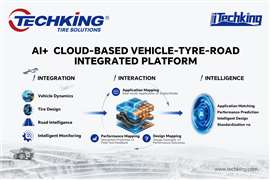 iTechking, AI+ cloud-based vehicle-tire-road integrated platform
Today, larger payloads, electric powertrains and autonomous machines are creating further demands.
Load capacity and heat management are still essential, but torque response and rolling resistance also require close attention.
Our development of the iTechking platform reflects the need to connect tire information with the machine and its operating conditions.
A high temperature reading becomes more useful when it’s considered alongside load, speed and road conditions.
I see our future role as being a development and operating partner, working much earlier with equipment manufacturers and staying involved with fleets throughout the service life of their tires.
The principle remains straightforward: understand the work, specify accordingly and keep learning from performance in the field.
--------
This article was produced by Tech Wang of Techking Tires, in collaboration with KHL Content Studio
--------
All images courtesy of Techking Tires
--------