Read this article in 中文 Français Deutsch Italiano Português Español
The height of performance: What makes a spider lift productive?
Partner Content produced by KHL Content Studio
12 November 2026
A spider lift may have enough working height to reach a building’s roofline, but it could still be unsuitable for the job.
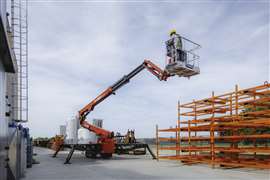 Productive access depends on reaching the working position, setting up effectively and manoeuvring around obstacles
It may be that a narrow entrance prevents access, an obstacle complicates positioning, or there may be insufficient room on the ground to stabilise the machine.
For contractors and rental companies, these constraints will determine whether the lift can deliver productive working time.
They also explain why the development of compact tracked platforms involves more than just extending their reach.
“Working height and outreach remain essential, but customers increasingly demand machines that are more versatile, compact, lightweight and easy to transport without compromising performance,” says Carloalberto Molesini, Managing & Sales Director of Platform Basket.
He adds that meeting those expectations means balancing requirements that can sometimes pull machine design in different directions.
 Carloalberto Molesini, Managing & Sales Director of Platform Basket
Start with the route to work
“One of the main challenges,” says Molesini, “is simply reaching the actual working area: maximum working height is not always the determining factor; narrow access routes, obstacles, ground conditions and available stabilisation space can all influence whether a machine can be used effectively.”
That makes the approach to a building, tree or maintenance location part of the equipment selection process.
Buyers need to understand the access route alongside the task at height, including restrictions that could affect travel and setup.
For rental companies, establishing those details with the customer can help identify a suitable machine before delivery.
Molesini says his design team has to remain focused, throughout the machine development process, on factors such as transport dimensions, weight distribution, tracked undercarriage manoeuvrability and flexible stabilisation.
“Our objective is to ensure operators can reach their working position safely while reducing handling difficulties and machine setup time.”
Balance reach with weight
As an example, Platform Basket’s Spider 30.14 offers a maximum working height of 30.4 m, maximum horizontal outreach of 13.6 m and maximum platform capacity of 250 kg.
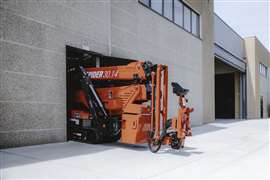 With its basket removed, the stowed Spider 30.14 demonstrates its ability to pass through a restricted doorway
The company lists a minimum stowed width of 0.89 m, a height of 1.99 m and an operating weight of 4,480 kg, depending on configuration.
These specifications reflect a design brief shaped by customers seeking greater reach while retaining the practical advantages of smaller equipment.
“Rental companies and professional operators increasingly require equipment capable of handling different applications without necessarily moving to larger and heavier machines,” says Molesini.
Delivering that combination requires intricate design work.
“Increasing working height and outreach generally creates greater structural loads, while reducing operating weight requires careful optimisation of every component.”
Platform Basket used engineering calculations and simulation tools to balance strength, rigidity and weight, with particular attention to boom geometry and weight distribution.
Electronic controls manage machine performance according to its configuration and stability limitations.
For buyers, this is a reminder that low weight and high reach need to be considered together with the conditions under which the machine delivers its performance.
“Our objective is not simply to achieve the greatest possible working height, but to deliver performance that customers can genuinely use in everyday working conditions,” Molesini says.
Examine the working envelope
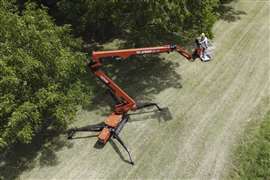 The Spider 30.14 combines a maximum working height of 30.4 m with an operating weight of 4,480 kg, depending on configuration
A maximum outreach figure says little about the route a platform must take to reach its destination.
Building features, branches and other obstacles can make boom geometry decisive.
The Spider 30.14’s double telescopic boom provides a stated 15 m up-and-over clearance, illustrating how articulation can help a platform reach beyond an obstruction.
The relevant question is whether that geometry suits the work and the available setup position.
“Customers should consider platform capacity under different operating conditions, boom geometry, the ability to reach over obstacles, stabilisation requirements and how easily the platform can be positioned,” says Molesini.
Load capacity also needs to be assessed against the intended combination of people, tools and materials, and the working position required.
Maximum height, outreach and capacity should be read alongside the machine’s operating information.
“Two machines with similar headline specifications may offer very different practical capabilities,” he says.
“We believe the selection process should therefore begin with the customer’s real applications rather than focusing exclusively on maximum figures in a technical brochure.”
Understand stabilisation limits
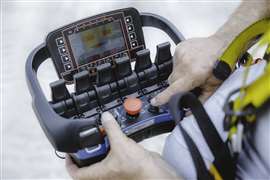 The lift’s remote control module combines operating controls with a display showing stabiliser status and machine information
Restricted setup space adds another consideration. A lift may pass through a narrow entrance but still need sufficient room and suitable ground to deploy its stabilisers.
“The ability to adapt stabiliser configurations to the available space is particularly valuable in urban environments, residential areas and jobsites with restricted access,” says Molesini.
The Spider 30.14 features automatic stabilisation and variable working area management, allowing performance to be adapted to the selected stabilisation configuration. This links the ground-level footprint to the platform’s usable reach.
“However, flexibility does not mean there are no limitations,” he says.
“Operators must always assess ground-bearing capacity, support conditions, inclination and compliance with the manufacturer’s approved operating configurations.”
That is particularly important when you consider the role of automation. Control systems can assist setup and manage performance within approved limits, but they cannot judge the suitability of the location.
As Molesini says, “Electronic systems will assist the operator, but they cannot replace an operator’s assessment of working conditions.”
Look beyond transport weight
Transportability affects how readily equipment can move between jobs and how it fits into an existing rental operation.
Although overall weight is an obvious starting point, Molesini says buyers also need to examine transport width and height, weight distribution, undercarriage dimensions, gradeability, loading and unloading.
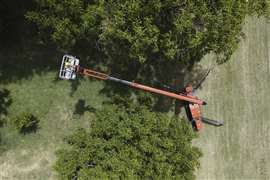 An overhead view shows the stabiliser footprint, highlighting the importance of assessing available space and ground conditions
“Compatibility with the customer’s existing transport vehicles is another important factor, taking into account legal transport restrictions and actual vehicle capacities.”
A compact lift’s suitability for a particular transport arrangement depends on the complete vehicle and load combination. Having a low machine weight does not on its own answer the question.
For a rental business, the commercial relevance extends beyond an individual delivery.
“Easier transportation can deliver significant economic advantages for rental companies, through improved logistics and greater flexibility in fleet management,” says Molesini.
Match power to the duty
The ability to undertake different applications also depends on the power configuration.
“The choice should primarily depend on the working environment and expected operating intensity,” says Molesini.
For extended outdoor use without reliable access to electrical power, he believes hybrid power could be a good option.
Fully electric configurations can also offer benefits for indoor work or where emissions and noise are critical considerations.
The Spider 30.14 is available in ED Hybrid form, combining a diesel engine with lithium battery electric power, and EL AC/DC, featuring an electric motor and lithium batteries.
Different battery capacities help customers select a setup suited to their planned applications.
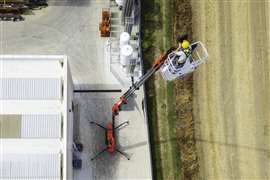 Positioning the platform beyond a site boundary illustrates why buyers must assess the complete working envelope
This is where it’s important that operators and rental businesses have a good understanding of the expected daily use and of access to charging or electrical supplies, as well as the locations in which the machine will work.
“Our objective is to provide different energy solutions while maintaining the platform’s essential operating capabilities,” Molesini says.
Extend the assessment to support
Once a machine enters service, its value also depends on how effectively owners can monitor its use and resolve technical issues.
Molesini explains that “Access to machine operating information, fault identification and diagnostic support can help reduce the time required to identify technical issues.”
Telematics can also support maintenance planning and give fleet managers greater visibility of a machine’s utilisation.
Platform Basket has developed a PBT system that provides information including location, operating hours and active and historical alarms.
The practical benefit comes from applying these insights to maintenance and servicing.
For manufacturers, Molesini says, remote diagnostics can strengthen the support available to dealers and service networks.
The same connection between operating experience and engineering informs product development.
He describes close collaboration between Platform Basket’s engineering, manufacturing, technical service and commercial teams.
“One of our strengths is the ability to collect feedback directly from customers and translate it into practical engineering solutions while maintaining direct control over the main stages of product development.”
For contractors and rental buyers, that brings the assessment back to the work itself: reaching the site, setting up within its constraints, positioning the platform and keeping it available for the next task.
Those are the conditions that turn a machine’s stated capability into productive working time.
--------
This article was produced by KHL Content Studio, in collaboration with experts from Platform Basket
--------
All images courtesy of Platform Basket
--------