



Read this article in 中文 Français Deutsch Italiano Português Español
Engineering confidence into aerial work platforms
Partner Content produced by KHL Content Studio
10 November 2026
For equipment users and buyers, recognising engineering quality in an aerial work platform (AWP) means understanding the design choices behind its headline capabilities – and what they deliver in use.
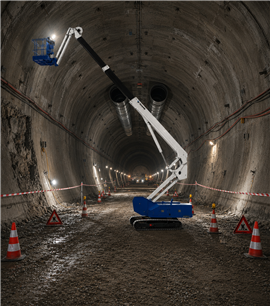 Effective AWP design balances reach, positioning and access to the work
Greater reach, more platform capacity, less weight and a smaller footprint all have their attractions. For designers, improving one characteristic can mean compromising another. A change that serves the work at height may complicate the journey there.
“A taller machine needs more weight or a wider base,” says Erik Elzinga, Vice President of AWP Business Development at Tadano. “Then you have to consider transport, the route to the work and the ground or floor conditions.”
The balance therefore must serve the entire operation. Quality lies in how successfully the design meets those combined demands, rather than whether every specification looks favourable on its own.
Strength, protection and access
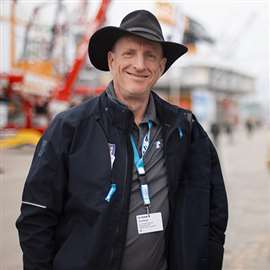 Erik Elzinga, Vice President of AWP Business Development at Tadano
A thicker boom mast assembly, for example, suggests greater load capacity. What else is that structure doing? On Tadano’s AWPs, it also houses all the hoses and cables that other manufacturers route externally.
“Enclosing the cable track takes more steel, but it protects the hoses and cables from debris and external damage, helping deliver a return on investment for our customers,” Elzinga says.
That protection is engineered within the requirements of each machine. A spider lift needs to pass through entrances and meet floor-loading restrictions. For a tracked boom, road transport or shipping containers constrain overall weight and dimensions. The engineering balance accommodates the longer-term benefit without sacrificing the machine’s ability to reach the work.
Bernie Duque, AWP Product Manager at Tadano, says: “The crane-style boom assembly gives you rigidity under load, with very little deflection. That makes a big difference to how comfortable the operator feels when working at height.”
The thicker boom therefore helps explain something that might otherwise be attributed entirely to the controls: how the platform responds during positioning.
“Everyone knows about the hydraulics and electrical controls, but there’s also the steel structure and how it reacts physically as to how the machine moves,” Elzinga says. “It’s this combination that delivers the smoothness and the secured feel to the operator.”
Protection without unnecessary interruption
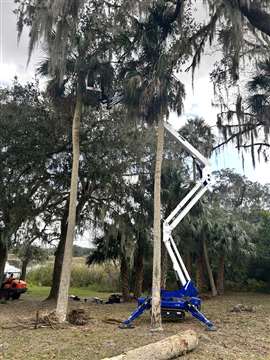 For tree-care work, boom positioning and the return to ground are practical tests of usability
Inside the platform, the operator’s physical behaviour also matters to load monitoring. People moving around the basket create temporary forces that affect the readings, even though the weight aboard remains unchanged. How does the manufacturer design for that activity without weakening overload protection?
“A good design takes that movement into account,” Elzinga says. “Manufacturers can dampen those effects mechanically, electrically or hydraulically, or use a combination of all three, to avoid unnecessary overload warnings and the machine stopping during normal work.”
When the AWP’s safety systems require the operator’s attention, the warning is deliberately intrusive.
“You want it to be annoying; you don’t want it to be a pleasant sound,” Elzinga says. “You also want to make it so the operator can understand what that warning is telling them.”
Can the operator quickly identify the problem? When an overload occurs, the working-envelope limit sensor and/or a possible obstruction would be detected by a safety system, which would require different responses from the AWP operator.
Machines using recognised industry symbols give operators a familiar reference across models. That consistency makes warnings easier to interpret—a practical benefit of quality design.
The same question of usability applies to advanced functions: does the technology simplify the task or add more for the operator to manage?
On Tadano’s Spider Lifts, a homing button activates the return to the stowed position. The system retraces the movements used to reach the working position, following the sequence in reverse along the same path.
Duque says: “When operators need to return to ground several times during a job, they would otherwise have to coordinate that sequence manually each time. One button replaces the repeated joystick inputs, making those returns simpler and more efficient.”
That is something operators can explore during a demonstration or practice session in a rental provider’s yard. Renting for the intended work provides a fuller test: are warnings readily understood, does normal basket activity cause unnecessary overload alerts or machine stops, and do the additional functions make the job easier?
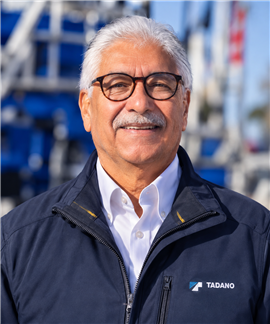 Bernie Duque, AWP Product Manager at Tadano
Those experiences help operators judge design quality through how readily they can understand and use the systems during their work.
Proving the design
A short trial cannot show how the machine will withstand years of work. For that, users and purchasers need to examine the manufacturer’s testing.
Thousands of completed cycles may sound reassuring – but what did each involve? The value of repetition depends on what is being repeated.
Elzinga gives the example of a hose that stretches as the boom passes through a particular position.
“If a manufacturer shortens a test or eliminates part of a movement, the hoses might not stretch as they would in long-term use,” he says. “The decisions about how the manufacturer tests are just as important as how it designs the product.”
Cycle tests examine component wear and durability through repeated use. Users and purchasers can ask which movements, loads and conditions were tested – and what was omitted – to establish how closely the testing represents their intended work.
Alongside that evidence of resistance to wear, what should users look for to judge the quality of the machine’s performance on site?
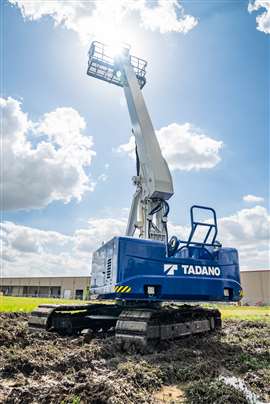 Tracked-boom performance in mud depends on both ground pressure and drivetrain capability
Field trials show how its capabilities work together in the intended environment. For a tracked boom in mud, low ground pressure helps support the machine, while the drivetrain must overcome crawler friction and retain enough power to negotiate the terrain.
Elzinga recalls a Tadano tracked boom lift being evaluated at a mine where the team had struggled to move wheeled platforms through muddy ground.
“They were overheating the gearboxes and motors of their wheeled machines just trying to traverse this ground,” he says. “They immediately drove our machine through the worst mud they could find. It drove right through.
“I know these machines are good, but I wouldn’t have driven it in there. Even I was impressed.”
Field experience also informs future engineering choices. Elzinga says Tadano draws on how components and construction methods have performed in previous cranes and AWPs, then involves customers during development and operators in trials of the new machine.
“We ask real operators to critique our machines,” he says. “Is the railing in the right place? Does the joystick feel right? Do the movements feel smooth?”
Users and purchasers can ask how that feedback influenced the finished design. The answer helps reveal whether engineering quality extends beyond durability and performance to making the operator’s task easier.
Where the choices lead
Combining capabilities can give crews a different way to meet those practical demands. Elzinga points to Tadano’s new AS-63HD.
“Once we developed a boom that could support 2,200lb in the basket within the machine’s overall size and weight limits, the evolution of the design was asking what else we could do,” he says.
“Could we provide a large basket with a continuous 360-degree platform rotation? Then could we add motion control, so it follows a wall, ceiling or roof without repositioning the chassis?”
Duque compares the result to two familiar machine types combined: “It has the capacity of a rough-terrain scissor lift with the reach of a telescopic boom, all in one.”
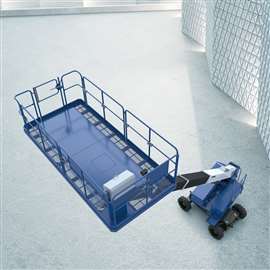 The AS-63HD combines a large working platform with the reach of a telescopic boom
For tasks such as cladding installation and decorating, that offers working space comparable to a scissor lift, with boom reach allowing work where unsuitable ground prevents positioning directly beside the façade.
Other possibilities may emerge once the machine is in users’ hands. Their knowledge of specialist tasks or different industries could reveal an application its designers had never considered.
“With more capacity, mobility and a large platform on the end of a boom, customers can design a different workflow for tasks we hadn’t anticipated,” Elzinga says.
Those discoveries can also inform further development. “Seeing how people adapt the equipment to tasks unfamiliar to us gives manufacturers new opportunities to refine its capabilities around the demands of that work.
And that is very exciting for us engineers,” says Elzinga.
That exchange between users and designers keeps the balance of capabilities tied to the work, even as new applications emerge.
A machine’s proportions, controls and behaviour become evidence of decisions made around those demands.
Understanding those decisions helps users judge what the machine offers today – and contribute to what it could become.
--------
This article was produced by KHL Content Studio, in collaboration with experts from Tadano
--------
All images courtesy of Tadano
--------