Read this article in 中文 Français Deutsch Italiano Português Español
Interview: Giga Rental on Brazil’s indoor hire scene

19 August 2026
São Paulo-based Giga Rental has deliberately taken a different route through Brazil’s access rental market to the more common construction sector. With around 700 MEWPs, the family-owned company focuses on indoor applications, particularly industry, logistics, exhibitions and events. João Guilherme, second generation manager of the business, explains why service, equipment care and reliability matter more than chasing rental rates.
Founded in 2004 by João Guilherme’s father Reneo, Giga is derived from the first two letters of his brother’s names Giovanna and Gabriel, who are also part of the business.
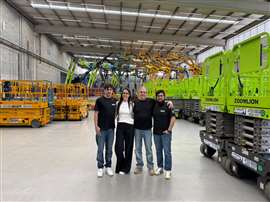 A family business. From left: Gabriel, Giovanna and Reneo, alongside interviewee João Guilherme. (Image: Giga Rental).
The company began with used Genie scissor lifts at a time when powered access was still a relatively new concept in Brazil. Today, the family business has a fleet of around 700 machines and remains focused exclusively on MEWPs.
João Guilherme has spent 15 years working full-time in the company. His father remains involved, maintaining the family ownership structure that has shaped Giga’s approach to investment and equipment.
“I started here and this is my first job,” João Guilherme says. “Everything I know is here.”
The company operates from a single main facility around 40 km from central São Paulo and covers a radius of approximately 200 km. Rather than pursuing a nationwide footprint, Giga believes its location gives it access to one of Brazil’s most concentrated industrial markets.
“We are close to the main highways, which is very important,” says João Guilherme. “We are around 20 km from the biggest road centre connecting the different parts of São Paulo state.”
He estimates that around half of Brazil’s GDP is generated within 100 km of Giga’s base, reinforcing the decision to remain regional.
“There is no need for us to broaden out from this area,” he says. “We have plans for new facilities and branches, but we will remain local.”
Indoor specialists
That regional focus is matched by a very specific customer strategy. Around 95% of Giga’s fleet is electric and the company concentrates on industrial sites, logistics centres, exhibitions and events rather than construction.
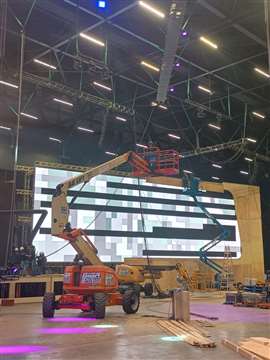 JLG, Haulotte and Genie boom lifts at an event fit-out. (Image: Giga Rental).
Around 70% of the fleet consists of scissor lifts, with the remaining 30% made up of boom lifts ranging from 8 m to 28 m working height.
“We are focused on industry, exhibition and event build-ups, and logistics centres,” João Guilherme explains. “Our core business is to send machines to indoor environments.”
Indeed, the company’s indoor philosophy extends beyond the customer. Giga keeps its machines inside its own facility when they are not working, rather than storing them in an outdoor yard.
The policy is part of a broader approach to equipment preservation. Machines return to headquarters for preventive and corrective maintenance, where Giga’s technicians can inspect, repair and refurbish them before they are sent back into the market.
“When you take care of your machines, you can use them for longer,” João Guilherme says.
Although Giga’s focus is on buying new equipment, some of its units bought in 2010-12 is still working today, meaning Giga is comfortable operating machines for considerably more than 10 years, while maintain its high level of quality.
Construction is not excluded, but Guilherme says it is not the company’s preferred environment. He believes industrial and logistics customers generally place greater emphasis on equipment condition, documentation, certification and operator training.
“In construction, the focus is often more on cost,” he says. “An industrial or logistics centre is much more demanding about the quality of equipment and the company that supplies it.”
That makes Giga’s service proposition particularly relevant. The company operates its own trucks and its drivers are trained by OEMs. They can deliver the machine, provide operator familiarisation and issue Giga’s own training certification.
GIGA Rental joined IPAF in July 2026, althouhg João Guilherme points out that Brazil does not have a unified certification framework like IPAF’s, but Giga places considerable emphasis on operator training, and the company joined IPAF in July 2026.”
The company’s customer mix also creates a specific rental model for the company. Less than 30% of its business is long-term, with a significant proportion coming from short-duration projects.
Events and exhibitions can require 20 or 30 machines for a single weekend, creating major logistical demands. Giga may deliver dozens of machines on a Friday and collect them again on Monday.
The rates can be higher, but João Guilherme says price is not the only reason Giga targets this segment. Customers expect absolute reliability.
“If they need the equipment at 10am or 10pm, it must arrive then,” he says. “It is like a wedding photographer. If I am delayed for the wedding, it is too late. There is no leeway.”
That precision helps generate repeat business and recommendations, which João Guilherme considers more valuable than competing aggressively on price.
“We do not fight on price,” he says. “We are more focused on performing well than on price.”
Five technicians for 700 machines
A key element of that performance is Giga’s in-house technical capability.
The company has five technicians supporting a fleet of around 700 machines – less than one technician for every 100 units. João Guilherme says this is considerably leaner than the wider rental market, where having one technician for around 25 machines is common.
OEM representatives visiting Giga are often surprised by the ratio. But João Guilherme argues that the relatively small technical team is possible precisely because of the company’s high level of in-house expertise and its rigorous approach to equipment preparation.
“We do the homework,” he says. “When you do good maintenance in-house before sending the machine to the customer, you are less likely to have surprises at the workplace.”
Rather than relying on technicians to resolve frequent problems in the field, Giga aims to identify and address issues at its headquarters before the machine is dispatched.
“If you keep an eye on the machine and control it very closely, you are going to be closer to perfection,” João Guilherme says.
The approach is also closely connected to the family ownership model.
“When you are in a family company and you are the decision maker, it makes a big difference to how you view your equipment,” he says.
Avoiding the price war
Giga’s strategy is being tested by a difficult Brazilian rental market. Guilherme says the past two years have seen increased competition from new rental companies and a growing influx of Chinese equipment.
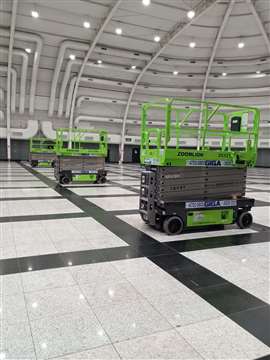 A pair of Giga Rental’s Zoomlion scissor lifts. (Image: Giga Rental).
Some new entrants have started with only a handful of machines, while other companies that previously operated in different equipment sectors have added MEWPs to their fleets. At the same time, larger rental companies have been buying new Chinese machines and disposing of older equipment.
That has created a growing second- and third-hand market, putting additional pressure on rental rates.
“The rental rates have dropped over the last two years for sure,” says João Guilherme.
Giga’s utilisation has consequently fallen to around 40%, compared with 60% or more previously. But the company has chosen not to follow the market down.
“I like to keep my machines at the facility rather than fighting on price,” João Guilherme says. “I need to pay the bills, but I also need to reinvest, buy spare parts, replace batteries and tyres and carry out maintenance.”
He argues that rental rates need to reflect the cost of keeping a fleet in good condition and replacing equipment over time. Companies focused simply on securing a payment at the end of the month can create problems for the wider market, he suggests.
Giga continues to benefit from longstanding customers who value its service and are prepared to pay accordingly. The challenge is winning new customers whose expectations have changed with the arrival of lower-priced alternatives.
Growing the fleet
Giga’s fleet today includes Genie, JLG, Haulotte, Manitou and Zoomlion. The company began investing in Zoomlion machines in 2022 and now has around 150-160 units from the Chinese manufacturer.
The decision followed around five months of discussions, including visits from Zoomlion’s sales and technical teams. João Guilherme also travelled to China to visit the factory and examine its manufacturing processes.
“We wanted to be confident that they were entering the Brazilian market in a serious way,” he says. “That is why we decided to invest in them.”
João Guilherme believes the arrival of Chinese manufacturers has ultimately benefited the market by forcing established manufacturers to reconsider how they serve customers.
“Ten years ago, the Chinese brands were lower quality and they did not have the parts, service and aftermarket,” he says. “Now they are very advanced, with new technologies, new ways of doing things and heavy investment in R&D.”
He also believes the changing supply of equipment is contributing to a structural shift in Brazil. Fewer new hydraulic machines are entering the market, while large numbers of older machines remain available, often at much lower prices.
The next investment?
Despite the company’s continued preference for new equipment, Guilherme is not currently planning a major fleet expansion.
“I have every size and every height in stock already, so it is not the time to buy new equipment today,” he says.
That decision is partly about market conditions and partly about Giga’s regional structure. National rental companies can move machines between regions if rental rates fall in one market. Giga, with its single main operating base, does not have that flexibility.
“If rental rates drop in São Paulo, the big companies can move equipment to another region where rates have not fallen as much,” says G João Guilherme. “We don’t have that option, so my strategy is to wait before buying new equipment.”
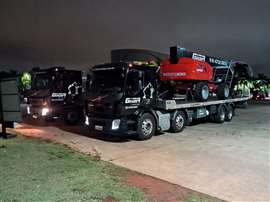 Two of Giga’s delivery trucks. (Image: Giga Rental).
Broader economic uncertainty is reinforcing that caution. João Guilherme points to high interest rates, inflation, political uncertainty surrounding Brazil’s presidential election and volatility in energy prices.
“Put together, it is not a good time to invest in our country,” he says. “But things will change.”
For now, he sees 2026 as a year for watching rather than expanding. “I see this year as a time to watch the market and be quiet.”
That does not mean Giga has abandoned its ambitions. There is already a small additional location nearby, used primarily by the sales team to remain closer to customers, and the company has plans for further facilities in the future.
But João Guilherme says expansion will only happen when Giga can replicate the standards of its existing operation.
“If we opened another branch, we would have to ensure it provides the same service as we do here – perfection,” he says. “I would need to double the technicians and the drivers, and it is hard to find those people nowadays.”
For a company that has grown organically from a handful of used Genie scissors into a 700-unit specialist fleet, that caution is characteristic of the business.
Giga is not trying to be the biggest rental company in Brazil. Instead, it is concentrating on being a highly specialised regional operator, protecting its assets, investing when the economics make sense and choosing customers who value service over the lowest possible price.
“We are big in our local area,” João Guilherme says. “And we will remain local.”
STAY CONNECTED




Receive the information you need when you need it through our world-leading magazines, newsletters and daily briefings.



CONNECT WITH THE TEAM