



Read this article in 中文 Français Deutsch Italiano Português Español
Choosing the right AWP for a constrained jobsite
Partner Content produced by KHL Content Studio
27 October 2026
There is often little room for adjustment on a constrained jobsite. Buildings, equipment, active works and existing infrastructure limit where machinery can travel and stand, leaving contractors to work out how to complete the task within the space available.
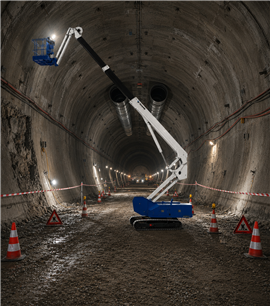 Tunnel work highlights the need to match an AWP’s reach and positioning capabilities to the space available
For work at height, those restrictions make selecting aerial work platforms (AWPs) a balancing exercise.
The machine must accommodate the people and materials required, reach from an available position and provide the movement workers need as the task progresses.
Improving one capability can mean accepting a limitation elsewhere.
The difficulty is judging those compromises before the work begins.
Some requirements can be measured and checked in advance; others depend on anticipating how workers will approach the task and what they may need once elevated.
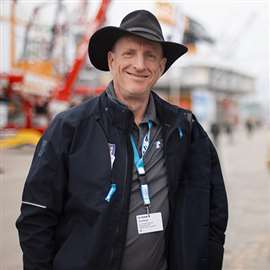 Erik Elzinga, VP of AWP Business Development at Tadano
“Foresight comes from considering how the task itself will unfold,” says Erik Elzinga, VP of AWP Business Development at Tadano.
“As work progresses, are you going to need additional people at height, different materials or a different range of movement? Those are the possibilities you need to consider before choosing the machine.”
Define the task: AWP capacity and boom configurations
Elzinga says a contractor can select a boom with enough reach for two people to work on a building, only to discover that the task needs another pair of hands or more material.
The machine must now provide that reach with the additional weight aboard.
“One way around it is always to rent the next size up,” says Elzinga, “but that comes with added cost, and a larger machine is harder to move and transport.”
Alongside the load, contractors need to establish the movements required at each stage.
Painting or fixing cladding may involve fine adjustments beside a façade after the boom reaches approximately the right position. A jib provides that movement at the end of the main boom.
“What customers are paying for is that added movement,” says Elzinga. “The value of the jib is in the flexibility it gives you to position the platform.”
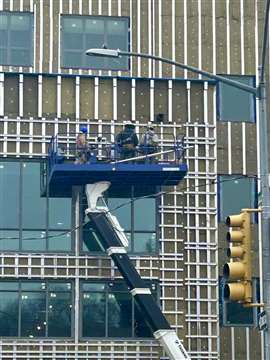 Tadano’s AS-63HD, with a maximum 2,200-lb (1-tonne) platform capacity, combines the outreach of a boom lift with the vertical lifting power of an RT scissor lift
Straight booms without jibs often offer greater platform capacity than jib-equipped models, which can make them better suited to some steel erection tasks.
Their simpler configuration also avoids an additional arm that could obstruct positioning around beams and connections.
Whichever configuration is chosen, the platform also needs to be aligned with the work.
Beside a wall, rotation allows the operator to turn the platform so its long side faces the façade, bringing the crew alongside the surface.
“The next consideration is how you move along that surface as the work progresses,” says Elzinga.
“On Tadano’s AS63 HD, for example, continuous platform rotation works with coordinated boom movements, so you can follow a wall vertically or a horizontal pipe or ceiling using a single joystick.
“You basically get the platform positioning performance of a scissor.”
Establishing operating positions
Those movements must be assessed from the positions the machine can occupy on the ground.
Obstacles such as ditches, trees and vegetation, stored materials, other machinery or existing structures and services may prevent a boom from approaching the building, increasing the horizontal distance it must cover.
Elzinga says a common mistake is to hire a 60-ft boom for a 50-ft building on the assumption that the additional height provides sufficient reach.
That overlooks the extension needed to reach across or over obstacles between the chassis and the point of work, potentially leaving the platform unable to reach the required position.
“Even a simple sketch of the site can reveal reach requirements that the building’s height alone won’t tell you,” Elzinga says.
“Comparing those heights and distances with the machine’s range-of-motion charts shows whether it can reach the positions the work requires.
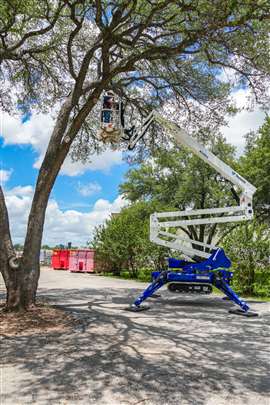 Tadano’s AL68 spider lift is often used in arboriculture operations due to its ability to maneuver through restricted residential or wooded spaces
“That information is available in the manuals, website specifications and brochures, and on decals on the side of the machine.”
For a crew painting a wall, that comparison shows how much of its height and width can be reached with the necessary people, tools and materials aboard.
The contractor can then identify where the chassis will need to stand as the work progresses, and how often it must be moved.
Access equipment for tight spaces
Each of those positions must be accessible, with sufficient space to maneuver.
“I remember, not too long ago, watching a wheeled AWP working in a deep excavation between buildings,” says Elzinga. “There was a crawler crane down there and very little room to move.
“The operator was doing a ten-point turn to get into position. I watched for maybe 20 minutes and he still hadn’t managed to do it.”
That operator, Elzinga points out, was steering from the elevated platform, where he could not clearly see all the wheels below. The limited view compounded the difficulty of turning the chassis in the space available.
“This is where a full-crawler AWP is a better choice,” says Elzinga. “On Tadano’s crawler booms, you can counter-rotate the two tracks and turn within the machine’s own footprint.
“A quad-track machine has four separate track units in place of wheels, but it still steers like a wheeled machine.”
Maneuverability at the operating position is only part of the access requirement. A narrow gate or doorway along the route may favor a spider lift, such as Tadano’s AL68 or AL97 models, whose compact width with the outriggers stowed allows it to pass through entrances too narrow for conventional crawler booms.
“When you’re choosing a spider lift, you’re trading the ability to travel at height for a lighter, narrower machine supported on outriggers,” says Elzinga.
That compact design typically means a smaller platform with less capacity for people and materials. For tasks involving frequent relocation, the access advantage also needs to be weighed against the time spent stowing and resetting the outriggers at each position.
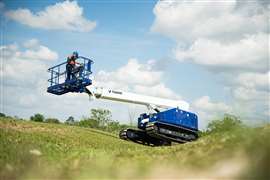 Crawler AWPs’ stability and weight distribution give operators the confidence to trust them on challenging terrain
Where the route crosses finished flooring or paving, protecting those surfaces adds another requirement – whether the machine’s weight and track or tire materials are suitable, or whether additional surface protection will be needed.
How ground conditions affect AWP selection
Outdoors, the assessment extends from protecting finished surfaces to establishing whether the ground can support the machine travelling across it.
A wheeled AWP may be suitable on firm, prepared ground, but can sink into softer terrain before reaching its operating position.
Elzinga points to a Wisconsin contractor planning to buy Tadano crawler booms for its tilt-up construction projects.
The company already uses crawler AWPs, working on ground that is cleared and leveled but not extensively compacted.
“The low ground pressure is key to making their method work,” says Elzinga. “Tadano offers crawler models with ground pressure as low as approximately 6 psi – roughly comparable to a person walking across the ground. The tracks spread the weight over a larger area.
“They save the time and money required to prepare the surface, and they can keep working when the rain and snow come.”
For contractors hiring equipment, those benefits help determine whether a crawler’s higher rental rate is justified.
Firm, prepared ground may favor a less expensive wheeled machine, provided it remains firm throughout the job.
For rental companies, the crawler’s versatility can extend utilization, with the AWP serving prepared sites in dry weather and continuing during wetter months when some wheeled machines return off hire.
Choosing the right AWP with your supplier
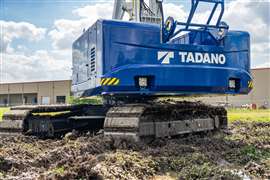 Crawler tracks spread the machine’s weight over a larger contact area, which is a key consideration when assessing access across soft ground
The conversation between contractor and rental provider therefore connects the capabilities of the available machines with the demands of a particular job.
Elzinga says the contractor may arrive with a general specification from a client or the project’s main contractor, but choosing the right AWP depends on the detail behind it.
“The specification might tell you how high you need to go,” he says, “but the discussion also needs to cover what you’ll carry, what you need to reach over and the ground conditions, including whether the surface will be prepared. Those details can change which machine is the most suitable.”
For Elzinga, the usefulness of the supplier’s recommendation rests on the detail the contractor shares about the site and how the work will be carried out.
A restriction left unexplained, a change in load left unmentioned or an incomplete account of the movements needed as the task progresses can mean a machine meets the stated requirements yet falls short of what the crew actually needs.
There may be little room to change the site, but there is room to think ahead.
Bringing the work at height and the restrictions below into the same conversation allows those compromises to be weighed while there is still a choice of machines – and before the limits of the equipment become the limits of the work.
--------
This article was produced by KHL Content Studio, in collaboration with experts from Tadano
--------
All images courtesy of Tadano
--------