Read this article in 中文 Français Deutsch Italiano Português Español
Interview: Genie president on sale plans and the next 60 years

01 April 2026
Genie is one of the true pioneers of the access industry and is celebrating its 60th Anniversary this year. Yet, the milestone comes at a transitional time for Genie and its parent company Terex. While Terex merged with specialty vehicle manufacturer REV Group in February, it also plans to sell Genie as part of a refocus away from the cyclical construction market.
The Genie name has been synonymous with the aerial lift sector since Bud Bushnell founded the company in September 1966, and according to current president Josh Gross, the aim is for it remain a dominant force for the next 60 years.
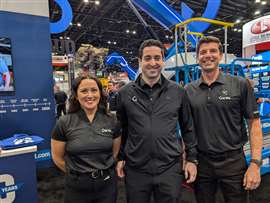 Genie management at the ARA Show. From left: Nicole George Vice President, Strategy & Brand Experience; Josh Gross, President; Ryan Crow, Genie’s Vice President for Global Product Management.
“There’s a lot of legacy and a lot of history around our impact on the industry and customer experience. So, we’re really excited about the next 60 years. The focus for us is we want to continue to be a differentiator on quality and total cost of ownership.
That boils down to three major pillars of investment. One of those pillars is innovation and investment in product, as well as developing service for its customers. “So that in every aspect of their interaction, they’re really feeling a premium experience and the highest level of performance that they would get in the industry.”
Other significant developments already underway can be seen in the growth of the Genie team, with numerous new employees joining the team and the promise that expanding the workforce will remain a major focus.
Another pillar is the drive to meet industry requirements. “We’re really thinking about how we better serve the industry and we’re spending a lot of money and a lot of time modernising our factories, investing in automation technology to help be more responsive to whatever customers need,” explains Gross.
“When we talk about installing robotics and AGVs and new technology, that helps make the factory very efficient but also enables us to respond to changes in demand. Because the market is cyclical and we need to be able to respond to that.”
Serving the industry also requires foresight adds Gross. “One of the things that we’ve learnt over the years is customers don’t always know what they need.” After all customers cannot always be certain of what’s coming next. “Maybe they win a certain project, and they have a certain set of products, so our ability to be flexible is the main focus.”
Global production footprint
Retaining Genie’s global production footprint is also a key part of the company’s roadmap. Its production facilities in the US, Mexico, Italy, India and China strategic asset and gives it a competitive advantage, Gross believes.
Next steps in automationOne of Genie’s latest innovations on show at ConExpo was a new concept device designed to provide material lifting support to the operator in the basket. The assistive material handling device was mounted on a scissor list basket frame at the show and was carrying a large panel that an operator would typically have to lift themselves. As Ryan Crow, Genie’s Vice President for Global Product Management, used the example of a dry wall installation. “Dry wall panels are very heavy, so we have vacuum end effector that can suck onto the panel and allow you to effortlessly move it into position and hold it there.” 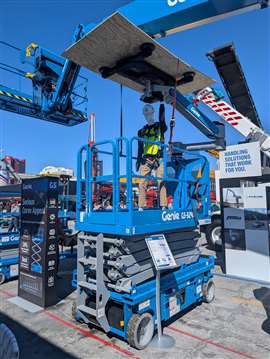 Genie’s assistive material handling device. Rather than being a robotic arm directly, it uses actuators, which means the operator pushes it into position, and uses robotic technology to compensate fully for the weight of the item. This means it is held in position, leaving the operator free to install it with their choice of tools. “This would not have been possible in the past because typically to have a high payload, you’d need an arm that’s so heavy it would tip the machine. So, there’s a lot of very interesting technology inside this, as simple as it looks, that makes this possible. While Crow says the device will not be production ready in the immediate future, he believes it could help reimagine how work is done through speed, ergonomics and productivity. “This is coming out of our technology development track where we’re thinking five, ten years ahead. Crow adds, “There will be a point where you’re going to see more automation at height. And this is the type of technology that would make that possible in the future.” However, the timing of its release is not fundamentally down to technology. “It’s not a technology issue when it comes to speed of adoption, it’s how does it fit into the workflow on a job site? What is the willingness of adoption - is it supporting jobs are replacing them?” “Our goal is to improve the productivity of work done by people using our equipment.” Nevertheless, Crow believes the business model and economics around automation are becoming more favourable. “When it comes to regulation, economics and technology, it is technology that is the easiest one to solve – it’s not going to be the hurdle, but we just need to be ready. Therefore, Crow adds, “We’re working on a lot of very interesting tech that is relatively stealth mode at the moment in that we don’t normally give teasers like this.”
|
For example, the China facility serves its domestic market but also Southeast Asia, the Middle East and parts of Europe. “So, it’s also a very important factor for us and we continue to invest and maintain our production and operations there.”
And its traditional manufacturing base in Redmond, Washington State, will remain a core element. “We’re making booms and scissors there, and we’re ramping up production there. There are no plans to do anything different with Redmond – it’s still an important factory for us.”
The longstanding big booms factory for the US in Moses Lake is about three and a half hours away from Redmond. “We’re investing heavily there too with some major technology Investments. We’re ramping up that one very aggressively.”
Gross adds, “We’re well positioned to kind of serve any market and from different angles and different perspectives depending on what happens.”
In a world where localised production has become increasingly attractive to companies looking to mitigate the effects of today’s challenges, not least tariffs, Gross believes the production footprint will also be a key focus for Genie’s future owner – whoever that might be.
The Genie sale
Terex unveiled plans to merge with US-based REV Group, which manufacturers speciality vehicles including fire trucks, ambulances, and recreational vehicles, at the end of October last year, and exit Genie, its aerials business, leading to widespread speculation over potential buyers.
However, we will have to be patient, as any announcement of a new owner could be some way off.
“We’re honestly very excited about it,” says Gross, “We’re being sold as a whole essentially, one group, we’re all together, all the plants and everything. And, we’re looking for the right ownership structure and investors that are aligned with our strategies, which is to deliver on accelerated growth.”
Indeed, Gross sees the sale of Genie as part of its wider strategy. “We’re working to scale up, modernise and continue to be leaders in the industry and differentiate in a lot of areas.
“And so, there’s a lot of different options. Whether that’s private investors, public investors or even spending into our own business. Everything’s on the table - we’re analysing what the best fit is for us and for the industry, and for our customers.”
Gross adds, “The timeline is a little uncertain but over the course of this year we’re going to be working on it as a high priority and we’re looking forward to the next step.”
Up until last October’s announcement, Genie had been a key staple of the Terex portfolio, but as Gross confirms there has been a shift in strategy. “I’m not in charge of Terex so it’s not all my decision but I think if you listen to like our earnings call, the strategy is changing. They [Terex] want to be more focused on municipal markets and different regions and a little less on construction.
“So, Terex’s strategy is going in one direction, and our strategy is a little different so we’re really just aligning with an ownership structure that will allows us to execute our strategy. It’s mutually beneficial.”
On the subject of timelines, Gross says a sale could be finalised in months, or it could take years. “Things could go really well and we find someone really quickly, which means it could be this year. Or it could go really slow – it could be years. We just need to figure out the right structure and the right support.”
Gross adds, “We’re going to be very transparent – ‘here’s where we’re headed, here’s what’s good, here’s our opportunities, here’s things we want to invest in and markets we want to focus on’. So, we are looking for a fit that 100% aligns.
“Then in the next five years, and the next 60 years, let’s go all in, let’s scale this thing up, let’s deliver to our customers and be leaders in our industry.”
Unsurprisingly speculation over a potential buyer has been rife in the industry. On that matter, Gross is openminded. “Again, I’d say it needs to be aligned with our values and our focus, and you’ve got to factor everything in,” which Gross points out could be geopolitical among other factors. “There are certain things that would be more risky than others. In the end we’ll do something that we think makes the most sense.”
The competitive landscape
One thing is for sure, all MEWP manufacturers are working in a much more competitive environment in terms of numbers of OEMs, which has resulted in the introduction of tariffs on MEWPs entering the US and EU from China. On top of that are wider duties on steel and aluminium products entering the US.
 Genie Zone Lights on the GS-1932
From Gross’ point of view, the only answer is to adapt to the times, “Every morning I look at my phone and there’s new news about something that’s changed in the world and so I think we’ve learnt in the last year this is an environment we’re just going to have to live in.
“There’s going to be new tariffs and new things that happen all the time, potentially for years into the future.
“And so, we take every new tariff or every new announcement both as a challenge and as an opportunity.”
Gross adds, “We have a strategy for being competitive and differentiating. We’ve learnt a lot, you know, over the last several years as the market shifted and there’s new competitors. And really that’s what’s caused us to reflect on our strategy and say, ‘what do we need to do for the next 60 years to be competitive?’
“It’s about that quality and total cost of ownership. How do we provide a premium experience, a premium performance, so that people see a clear difference between us and our competitors?”
“So, we’re leveraging our Global footprint, and we’re leveraging our product strategy, whatever happens. We look for opportunities to better serve our customers and optimise is essentially what we what we’ve done.”
Despite the need to adapt, Gross believes Genie’s history of quality plays into its hands, “the other thing that help us, as some of the newer competitors’ machines start to age and there are different requirements in terms of service and aftermarket support and digital requirements.
“We’ve been in the market for so long, we understand how to deal with the 20, 30, 40-year-old machine - how you service it well how do you maintain it.
Gross adds, “So, in all these scenarios, we’re looking for someone who will help us accelerate those journeys more than anything.
“We are not looking for someone to make us more competitive. We have a good plan to be more competitive, and we need someone who believes in that plan and helps us execute the plan.”
“Nothing is pausing. We’re spending more money this year than we did last year on new product development and all sorts of other things. And the same with digital and processing systems. We’re really ramping up, despite being sold.”
The future of reconditioningAt the ARA Show in Orlando earlier this year, Genie launched Recon, it’s new reconditioning business, with a reconditioned S-65 boom lift will on the stand. Genie said reconditioned units mirror the same quality levels applied to new equipment, using genuine Genie parts and quality assurance processes. Each machine undergoes detailed inspection, functional testing, and targeted upgrades to ensure like-new consistent performance, safety, and reliability. Every reconditioned unit is backed by a three-year warranty. 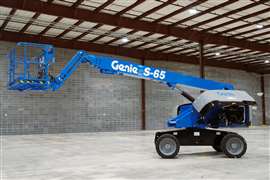 A newly reconditioned S-86 boom lift from Genie Recon. (Image: Genie). Speaking to Access Briefing at the ARA Show, Ryan Crow, vice president global product management at Genie, said while Recon was a relatively new venture the plans are to scale up the offering with further models in the future. “We’ve taken the approach where we will take a core and basically strip it and we’ll assess the pieces - all the parts.” Then there are three options: replace used components with new ones, keep some of the existing structural components and use remanufactured like new parts. “The we put it all back together and follow exactly the same quality standards and procedures as our factory. It comes out like new with a three-year warranty.” As Crow explains the Recon is important in the modern era as its offers three TCO benefits. “For smaller independent companies, they will now have a like new warranty backed machine at a much more competitive price point. “For the larger, more established companies, you have more variability and flexibility with your fleet. Second, it improves the residual value when you have a pathway to add more value to the machine. “That’s important for a rental company when they get to that roughly seven-year window.” Crow adds, “Thirdly, we’re seeing a lot of interest in what we call it Recon and return. Essentially, if you’re a rental fleet and you take really good care of your equipment, often you want that same piece of machine back after it’s been reconditioned - we’ll recondition it and send it back to you.” Concluding, Crow adds, “Overall it’s really good environmentally, ecologically and economically for our customers.” |
STAY CONNECTED




Receive the information you need when you need it through our world-leading magazines, newsletters and daily briefings.



CONNECT WITH THE TEAM