Read this article in 中文 Français Deutsch Italiano Português Español
Interview: JLG president on his vision for technology and markets

07 April 2026
Access Briefing caught up with JLG president Mahesh Narang at the ConExpo exhibition in March, along with the company’s chief technology officer Shashank Bhatia, to find out how the company sees the future through its range of policies and product developments.
JLG remains the world’s largest access equipment manufacturer and the company’s president Mahesh Narang plans for it to remain that way through a combination of technological advances, high-quality products and service, along with its continuing Local for Local production program.
Narang is also clear that high quality must be supported by sensible pricing, which is having a positive impact on JLG’s main market, the USA that has been reflected in its results.
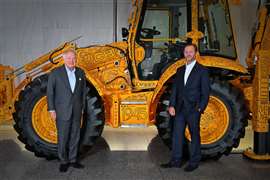
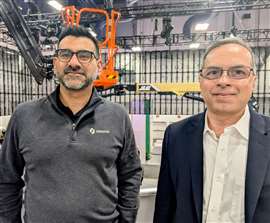 Mahesh Narang, President of JLG (right), with Shashank Bhatia, Chief Technology Officer and Global Vice President of Engineering.
Parent company Oshkosh Corporation announced earlier this year that its Access Segment, namely JLG had seen sales increase 1.3% to $1.17 billion in the fourth quarter of 2025, compared to a 13% fall across the year to $4,494.4 million.
Narang, who is Executive Vice President and President of the Access Segment, confirmed that overall, the construction market had been slow, but explained a range of factors was affecting the sector overall.
“When we look at the age of the fleet or we look at utilisation of the fleets, it’s pretty robust. The only thing stopping customers from buying the product is the volatility in the markets with the macro environment.
“So, they are holding on to older equipment a little longer and so that’s really why the market is a little softer.”
However, while construction has been relatively weak, other sectors are seeing long term growth. “The markets that have kept going are data centres and some mega projects.”
Narang describes data centres as a trend that unstoppable. “It may correct a bit but that’s where the future is going.”
That trend was reflected on JLG’s booth at ConExpo, which took place in Las Vegas during March this year, where the company was showing a range of cutting-edge technologies leverage by its ClearSky offering. Narang comments, “If you look at all the automation on our booth, to compute all that data, you will need more data centres.”
Indeed, they will be vital in the next stages of JLG’s development. “You can see the productivity benefits that you get when you can start using data and AI to automate jobs.”
Expanding further on the uptick in the fourth quarter of last year, Narang says, “What happened in Q4 was we were not cost by price neutral as a company because of inflation and various other things that are happening in the world.
“So, to be cost price neutral, we raised prices. And what we saw in Q4 is customers buying ahead of the price increase and that’s why you saw our Q4 being higher than normal.”
Narang adds, “And that’s why our guidance for 2026 is slightly lower than last year, because we pulled ahead from 2026 into Q4.”
The price increases were mainly the US market, however. “In other parts of the world we have been able to make supply chain improvements to manage [the situation], but we’ve not been able to offset the impact in US. For example, US steel has gone up with Section 232 [duties on steel and aluminium imports], so, products in the US have gotten more expensive.”
Localised manufacturing footprint
At last year’s Bauma exhibition in Munich, Germany, JLG announced its Local for Local drive towards regional production, which has already had a positive impact, says Narang. “We are in the final stages of executing our Local for Local strategy. It has really helped us in reducing the cost of our products which are made in Europe, and that’s why we’ve not had to make any price increases in there.
“In fact, it is also helping us grow in the European market, which was a vision we laid out through Local for Local.”
In 2024 the European Commission hit imports into the EU with an anti-dumping duty of more than 20%, adding to US import taxes on Chinese MEWPs introduced in 2021.
Last year, companies were further impacted by the economic upheaval surrounding the Trump administration’s plans to introduce tariffs on goods imported to the US from around the world as well as the separate Section 232 steel and aluminium tariffs.
That said, Narang supports tariffs when placed fairly. “Tariffs encourage fair competition. We are proponents of fair competition, but when certain companies or regions have an unfair advantage, it becomes difficult to reinvest in innovation.”
While the introduction of tariffs on MEWPs prompted a reorganisation of JLG’s production footprint, feeding into the wider localisation plan, the outcome has proved to be favourable. “We love fair competition and the purpose of all the prohibitions – countervailing duties as we call it – is to enable fair competition.
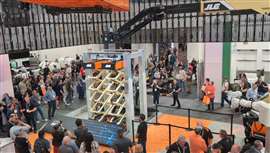 The welding end effector prepares to weld the steel beam.
“It started in the US, and we are super glad Europe did it too. These are the two biggest AWP markets in the world, and when we have fair competition, we can reinvest the money we make in future Innovation.”
Following the US tariffs and as part of the Local for Local scheme, the company opened a new R&D facility in Frederick, Maryland facility in the US, along with a new 500,000 square foot telehandler production plant in Jefferson City, repurposing an Oshkosh Defense facility, which Narang says is now ramping up production.
The same concept has been introduced in Europe with production of selected diesel and electric boom lifts going to its Hinowa plant in Nogara, Italy. The first unit rolled off the line in April last year, and the integration of booms to the heavily expanded facilities in the country is complete.
Now, the plan it to move telehandler production in Europe to Ausa’s facilities, after Oshkosh acquired the Spanish manufacturer of telehandlers, dumpers and forklifts in September 2024.
In China, JLG’s plant was repurposed, with models destined for Asia having been moved there to match regional demand. In recent years the company has transitioned from high-volume production of a few models to a wider range of lower-volume models, with that process now continue. “We also continue to use that plant to grow share in Asia,” adds Narang.
An up-and-coming facility can be found on India where the company is reacting to dynamics of the market. “We needed to develop a supply base in India for scissors, and that’s in the process of happening now.
“We’re going to leverage the supply base there build some components and small products for export.”
Pricing dynamics
Returning to the US and asked how customers have reacted to those price rises caused partly by tariffs on steel imports, Narang replies that the situation is more complex than tariffs alone.
“Actually, I go would call it general inflation versus tariffs because it’s not just tariffs. There are other factors, such as labour costs in the US, as an example, steel prices have gone up as the mills have come back to profitability.
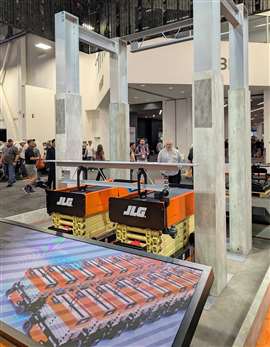 The leader follower scissor lifts with steel beam waiting for the command to lift it into position.
“Customers have accepted a fair portion of the price increases and our guidance is we will be cost price neutral for the year.”
While JLG has put its prices up, Narang says he hasn’t yet seen other companies in the sector follow suit. “So, we hope they catch up at some time.”
Either way, Narang firmly believes that the best product generally wins in the end. “If you see our booth, the products we have launched have had an extremely good reception.”
More than this, adds Narang, “When we are able to lower the total cost of operation for customers, they always come back to us. And so, we’ve actually been able to grow in a declining market in a lot of the areas with some of the innovative launches we’ve had.
“We feel good about the product pipeline we have, and we will continue that trend.
As Narang previously mentioned, one of the benefits of fair competition, is that it allows for healthy profits, which in turn makes product investment possible. One of those recent developments has been in JLG’s micro scissor range primarily for work in data centres. “We wouldn’t have been able to do that if it wasn’t for fair competition.”
Expanding on the rapid growth in data centres, Shashank Bhatia, Chief Technology Officer and Global Vice President of Engineering at JLG, says it has presented a gap in the market.
“We recognised there was a gap where compact manoeuvrable scissor lifts were not there, along with the fact that what the market wanted was safety systems on them - those being when the scissors come close to an object or a person they stop.”
Technological leaps
On the booth at Conexpo was JLG’s 19ft micro, launched in the fourth quarter of 2025, accompanies by a 26ft model introduced in February. They all come with a mid-rail step up deck allowing operators to work through small ceiling panels, which is a particular feature, and Sky Sense - the company’s obstacle detection system. “They’ve been successful and we will be coming out with other products soon.” This will include a 25ft working height vertical mast lift that is even more compact.
Bhatia confirms that although the data centre market may not continue to see such explosive growth and will likely level off, there is no stopping the trend. “They are investing billions of dollars, so data centres are here for the future.”
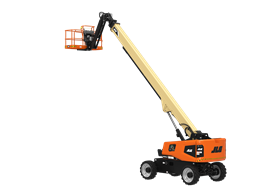 The JLG 860SJ+ is previewing at ConExpo. (Image: JLG).
Bringing the discussion back to the company’s latest technological developments, Bhatia points to the end effector and leader follower innovations that were on JLG’s stand at ConExpo, where it was presenting the ‘jobite of the future‘. It sees a pair of scissors being used as material handlers to autonomously travel with a steel beam, before lifting it into place, where a boom lift, with a robotic welder end-effector attached, welds it to the frame. Overseeing all this is an operator who remains on the ground.
Narang says, “To do this, you need to process data and images very quickly, and you can’t do that with local computing. You have to send it to a data centre to compute it and send it back.
“There will be more and more moments of autonomy that will be launched in the world. And that’s the future of our products too - executing jobs through connecting a product to other connecting ecosystems.
“The safest place for an operator is on the ground. So now we want the operator to be on the ground and let the boom weld it at 60 feet.” (See box story for further details).
The safety and productivity advantages of the technology are clear, although its introduction to real jobsites will come in phases.
“The way I would describe it is we’ve gone from concept to prototype,” says Narang, “Then we go from prototype to production. We are carrying out pilots with customers and based the pull we will release them.
“Some technologies will launch faster. For example, the canvas robot will be generating revenues this year for autonomous drywall sanding.” At the show, JLG unveiled the drywall robot from Canvas Robotics, following JLG’s acquisition in January of the core technology developed by Canvas, a San Francisco-based construction robotics technology company known for robotic solutions for interior construction applications.
When it comes to end effector technology, there are simple features like ‘go home’ and ‘back to where you were’ buttons on the boom that are already achievable and the leader follower technology on the scissors that is pretty close.
“The welding technology is a little farther away,” adds Narang. “So, we’ve developed technology stacks and we are working with our end users and rental partners. And every few months, we will keep launching new features through our Clear Sky platform.”
“It won’t be like we suddenly have a revolutionary product in five years’ time. Everything you see will be launched in phases over the next few months and years.”
The dynamics of competition
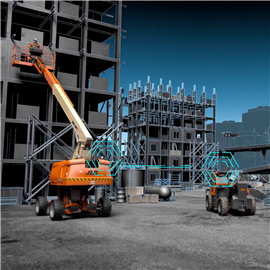 JLG’s ClearSky Smart Fleet management solution is being used to enable machine to machine communication. (Photo: JLG Industries)
As Narang has described, such innovation and investment will help the company remain competitive into the distant future and it is confident that the company will built market share in the emerging markets where some of its competitors have taken market share, thanks in part to lower priced products. This is an area in which JLG will never compromise, says Narang.
“The way I would summarise it is, we don’t compete on price. We compete on life cycle and on innovation and we may not have the same market share outside the US, but we are still known as the market leaders.
“We are always there in demanding applications, and we wait for the market to mature and then we grow in that market. So, every market has its face and we will grow over time.”
Besides markets and technology, there has been another seismic development in the access industry; that being the proposed sale of Genie - the world’s second largest MEWP manufacturer after JLG. by its
How does Narang feel about the move by Genie’s parent company Terex, now that it has merged with the REV group? “I just hope it’s a responsible buyer, “he says. “We like to have a strong number two in the market. They are a good company and I just hopeful they sell responsibly.”
STAY CONNECTED




Receive the information you need when you need it through our world-leading magazines, newsletters and daily briefings.
CONNECT WITH THE TEAM