Read this article in 中文 Français Deutsch Italiano Português Español
JLG to present new autonomous lifts and AI advances

21 December 2025
JLG has shared more information about its new generation autonomous boom lift with End-Effector, which is now in advanced development, and its complementary Leader-Follow concept, set to be installed in micro scissors, as well as delving into its current and future use of artificial intelligence in construction and beyond.
The insights came during parent company Oshkosh Corporation’s media briefing ahead of Las Vegas-based tech show CES 2026, in January, at which the prototype products will be displayed
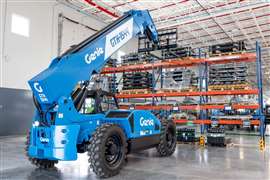
 JLG’s concept Boom Lift with End-Effector. (Image: JLG).
Speaking during the online event Jay Lyengar, Chief Technology and Strategic Sourcing Officer at Oshkosh said the End Effector system is being designed to carry out a range of typical tasks, including welding, high pressure cleaning and material handling without requiring an operator at height.
“It turns a traditional boom lift in to an industrial scale robotic system and in the future this electric boom lift can be autonomously recharged with a mobile charging robot,” said Lyengar.
Also at the show will be a pair of autonomous micro scissor lifts incorporating Oshkosh’s new Leader-Follow technology. Explaining the concept Lyengar explained, “Visualize two lifts that move and lift a high beam into position synchronously then notify a nearby boom lift that is in place and ready for welding through our Clear Sky technology.
Additionally, said Lyengar, “These micro sized scissor lifts are also ideal for the growing data center markets where space restrained jobsites require compact lifts. So, with these types of solutions the jobsite of the future goes from enabling jobs to executing jobs through a connected eco system of machines, people and materials.”
Pictures of the micro scissors are not yet available, and we will have to wait until CES 2026 to see them in action.
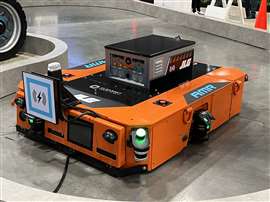 JLG’s Autonomous Mobile Charging Robot (AMCR), shown at CES 2025, is designed to take electric charging to the equipment on a jobsite. (Photo: Becky Schultz)
Product developent phases
Replying to a question from Access International during the online media briefing, Lyengar said the boom with End Effector was in an advanced development phase and laid out the steps that need it be taken to meet real world jobsites.
“It is about the type of end effector that will be in the specific end application, whether it’s painting, welding or dry walling. Each one has slightly different robotics, so our efforts are now to have clearly autonomous robotics, using our technology, as well as having the right type of End Effector robotics platform that is scalable across multiple applications.”
On the subject of timescales Lyengar said JLG would continue advanced development work during 2026. “We will be working very closely with customers – we always keep the customer in the loop and make sure we understand the requirements and are designing technology for the given application.
“After that we have to go through the usual product development cycle so it will be a few years out.”
Expanding on the point, John Pfeifer, president and CEO of Oshkosh, added, “I think the best way to look at it is you will see us start to apply it the most simple use cases first, that are consistent and relatively simple, like window washing or certain types of welding. Then it will be gradually expanded years and years into the future.”
Smart fleet connectivity updates
Linking the jobsite ecosystem is JLG’s ClearSky Smart Fleet IoT, for which there will be two new features, coming soon.
The Digital Access Control and Over-the-Air Machine Software Updates will be available through the ClearSky connectivity beacon on JLG machines, meaning equipment owners and fleet managers will be able to send prompts to the beacon to digitize historically manual daily processes.
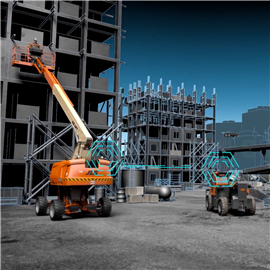 JLG’s ClearSky is set to updated. (Image: JLG).
The Digital Access Control feature allows users to restrict or enable machine operation using the ClearSky mobile app, eliminating the need for manual keypad entry. With the introduction of Over-the-Air Machine Software Updates, JLG has also digitized the once manual process of updating machine software. Traditionally, annual ANSI-required updates require a technician to visit each MEWP in person, connect a laptop, install the software and reprogram machine personalities — a labour-intensive process.
Advances in artifical intelligence
Complementing all this will be advancements in artificial intelligence, which Oshkosh is increasingly using to its advantage. Speaking during the pre-CES call, Pfeifer explained how Oshkosh was developing its use of AI agents to streamline supply chains and commented about their role in construction - and ultimately the boom End-Effector and scissor Leader-Follow concepts.
As Pfeifer said, there can be multiple AI agents in a workplace, each given access to the data points in a specific area, which it can then interrogate and report back predictive solutions.
Pfeifer pointed out that construction jobsites are an ideal area for the use of AI agents, as they are currently, “Dynamic, chaotic, unpredictable and complex.
“Each jobsite is unique, and productivity often stalls due to equipment downtime material delays and uncertainty about a tool or machine readiness.” This, added Pfeifer, is exacerbated by the labor shortage.
One area where Oshkosh is already using AI agents is in the supply chain. “Using AI agents that are able to access the vast amount of data that we have coming from our supply chain allows us to continue to find opportunities to be more productive in our own operations…and we can also do that for our customers.”
Real time data points
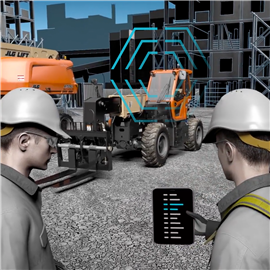 Remote updates via JLG’s ClearSky. (Image: JLG).
Using another example, Pfeifer said an AI agent at an airport can take hundreds of data points in real time as an aircraft approaches a gate and learns what happens at each of those data points. “When different data points line up in a certain way it knows what is going to happen five or 10 minutes later and can tell people on the ground what is needs to do to avoid a delay.
“AI agents are a fundamental part of how we are designing and solving problems for customers on site using AI.”
Service centers are also ideal for the use of AI agents, Lyengar said, “Our service repair centers are getting more and more complicated. AI agents can give very targeted repair instructions that reduces the turnaround time in repair and get the aftermarket parts ready and available - the potential is unlimited.”

CONNECT WITH THE TEAM