Read this article in 中文 Français Deutsch Italiano Português Español
Low level access - out of the niche

07 September 2026
Low level access is developing into a broader category, with manufacturers focusing on compactness, ergonomics, productivity and increasingly specialised applications, while data centres are providing a wealth of opportunity.
JLG has expanded its low level range with products aimed at different working environments. In North America, its latest push-around addition is the 1230P, while in EMEA the company has introduced the Nano 30CS and Power Tower CS confined-space models.
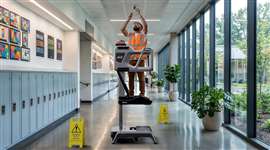 JLG’s Liftpod fixing a camera in a school hallway. (Image: JLG).
It has also added the LiftPod, a manually operated folding machine aimed at front-of-house environments. The 1230P provides a 17ft 4in working height and a 440lb platform capacity. Its 28in x 33.5in platform and lightweight construction are intended for applications where access through doors and elevators and low floor loading are important. A vertical rail system provides platform protection, while auto-lock brakes engage when the machine is elevated.
The confined-space machines address the need to reach overhead services where conventional access equipment is too large. The Nano 30CS has a 550mm x 550mm platform, a 4.95m working height and a 200kg safe working load. It can raise an operator through a ceiling-tile opening to work in ceiling voids. The Power Tower CS has a 5m working height and 250kg working load, with a base-mounted platform and interchangeable basket.
JLG is also addressing material handling at height with Power Tower attachments including a pipe rack and board carrier. The LiftPod, meanwhile, provides working heights of 3.2m or 3.5m through a manual folding design requiring no fuel, mains power or batteries.
JLG’s Andy Menham, low level access business development manager – Europe, says future development is likely to include taller confined-space platforms while retaining the compact dimensions required in restricted indoor environments.
Residential work
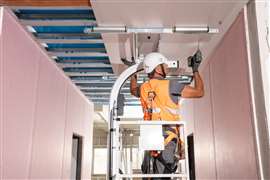 Bravi demonstrates ease of use with the Residential 170. (Image: Bravi).
Bravi Platforms has taken low level access into residential construction with the Residential 170. The push-around machine has a platform height of 1.7m and a 3.7m working height, while its 66cm width allows it to pass through relatively narrow doorways and hallways. Its 360kg weight is also intended to make it suitable for finished or sensitive floors.
“The Residential 170 [was designed] to meet the specific needs of this expanding sector, combining safety, simplicity, and efficiency for indoor environments,” says Bravi CEO Pierino Bravi. Bravi says the machine can reduce operating times by up to 50% and ladder-related accident risks by as much as 75%, citing European safety data. The company is targeting residential construction at a time when labour shortages and an ageing workforce are increasing pressure to reduce physical strain and improve productivity.
Bravi has also expanded its Leonardo range with the Leonardo HD 430, positioned between the existing Leonardo HD and Lui 460. The machine offers a 4.3m platform height and 6.3m working height, with a 760mm width, 680kg weight and 180kg capacity. It is designed for indoor environments and tight spaces, with zero turning radius, non-marking tyres and automatic pothole protection.
For Axolift, the latest development is the P300X, its first outdoor-rated scissor lift. “Our goal is to strengthen our presence among rental companies by offering a versatile machine suitable for a wide range of both indoor and outdoor applications,” says Massimo Grossele, CEO of
The P300X can operate on slopes of up to 35% and has an IP55 rating. It incorporates pothole protection, forklift pockets and basket extensions on both sides, while retaining a low overall weight. Grossele says requirements vary significantly by market.
Some favour machines that are “as compact and lightweight as possible”, while others want more versatile equipment capable of operating indoors and outdoors and accommodating two operators. The Middle East is one such market, with data centre construction and major construction projects generating demand for machines covering a wider variety of applications. In markets such as the UK, where low level access is already established for maintenance, installation and facilities management, demand is more focused on equipment that is compact, lightweight and easy to transport.
A new strand
One of the most significant developments in the sector is the emergence of micro scissors as a distinct low level access option. Rather than simply being smaller versions of conventional scissor lifts, these machines combine powered elevation and driving with exceptionally compact dimensions.
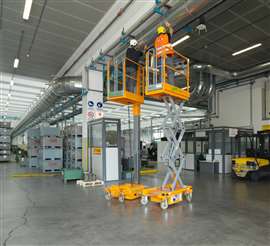 The P300 is set to strengthen Axolift’s presence among rental companies. (Image: Axolift).
Genie has developed its micro scissor range alongside slab scissors and vertical mast lifts. Its GS-1432m and GS-1932m machines can be fitted with an Integrated Access Deck, providing an additional 19.7in of height for reaching into restricted overhead spaces.
Genie’s Corrado Gentile, product director for scissors and verticals, says there is “a growing demand for low-level access that can lift people and material higher”. At the same time, there is “less of a focus on equipment that can carry two operators, and more of a focus on compact equipment with the capacity to lift a single operator along with all of the necessary materials and tools.”
Genie’s Lift Guard Zone Lighting uses red laser beams to create a visible perimeter around the machine, while Lift Guard Sense provides progressive warnings of overhead obstructions, slows machine functions as an obstruction approaches and can ultimately cut off functions.
Skyjack is also expanding the micro scissor category with its SJ3213 micro and SJ3219 micro models. The machines use front-wheel electric drive, providing quiet, zero-emission operation. Their compact dimensions allow them to enter passenger-style elevators, while their platforms provide substantial floor space for the micro category.
A telescoping extension deck increases usable platform area, while low gross vehicle weight and floor loads are intended to minimise the impact on finished floors. Skyjack’s vertical mast range, including the SJ12 E, SJ16 E and SJ20 E, provides another route into low level access. Electric drive gives controllability and gradeability, while the rigid multi-stage cylinder mast is intended to reduce maintenance.
The mast top aligns with the platform rails, which is useful when working beneath suspended ceilings. Haulotte entered low level access in 2022 with its Move Up and Swift Up ranges, covering push-around and self propelled equipment below 6m. Its current push-around offer is centred on the Quick Up range.
The company says the key characteristics of low level access remain “compact dimensions, low weight, ease of use and ease of transport”. These are particularly relevant indoors, where machines have to move through buildings, operate on sensitive floors and be repositioned frequently.
Haulotte sees a shift away from selecting equipment simply because it reaches a particular working height. Customers increasingly expect machines to deliver mobility, versatility and productivity across a wider range of applications.
“Low level access is becoming a broader proposition than simply reaching low working heights,” Haulotte says. “Customers increasingly expect compact equipment to deliver mobility, versatility, ease of use and productivity across a growing range of applications.”
Electrification is important for indoor use, but productivity and total cost of ownership are also becoming significant purchasing criteria, alongside low maintenance requirements and ease of operation.
Safety and productivity converge
The wider trend is towards equipment that replaces ladders not merely because it is safer, but because it can make repetitive work more efficient.
JLG’s Mirco Negri, senior product manager – specialty equipment, identifies the search for ergonomic alternatives to ladders and scaffolding, restricted working environments and environmental considerations as major influences. “Low level lifts are designed and purpose-built to reduce strain on the body and lessen the risk of musculoskeletal injuries caused by repetitive movements,” Negri says.
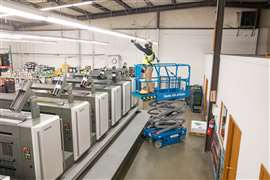 A Genie GS-1932m in a print production facility. (Image: Genie).
The ability to work hands-free is another distinction. On a ladder, an operator may need one hand for stability; on a platform, both hands can be used for the task. Compact machines can also be lowered and moved between work areas, reducing repeated climbing.
The physical environment is equally important. Hospitals, universities, offices, retail premises, museums and data centres increasingly require quiet, compact machines that can operate around occupants and sensitive infrastructure. Battery-electric and manually powered equipment can reduce noise and, in some applications, eliminate direct emissions.
Data centres drive demand
Data centres have emerged as one of the strongest growth applications. Construction requires electrical installation, cabling and HVAC work, while completed facilities require continual maintenance. Both phases involve congested spaces and overhead services.
Genie identifies North America and Europe as its strongest markets for low-level access, with data centre construction a major contributor. It is also seeing increasing demand from India, China and the wider Asia-Pacific region. JLG similarly points to large-scale investment in data centres as a factor behind the expansion of low-level access. Axolift sees the same effect in the Middle East, where new facilities generate demand during construction and subsequently for maintenance.
But the market is not dependent on data centres alone. Manufacturers cite hospitals, warehouses, logistics facilities, retail outlets, airports, museums, restaurants, cafes, education buildings, hospitality venues and general facilities management. Fit-out and finishing work are particularly suited to compact access because machines are repeatedly repositioned and often have to work around completed interiors.
A broader category
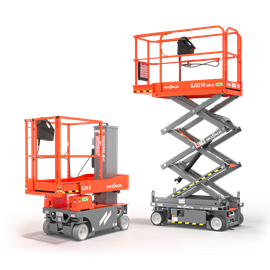 Skyjack: The 3219 micro and SJ16E from Skyjack. (Image: Skyjack).
But the market is not dependent on data centres alone. Manufacturers cite hospitals, warehouses, logistics facilities, retail outlets, airports, museums, restaurants, cafes, education buildings, hospitality venues and general facilities management. Fit-out and finishing work are particularly suited to compact access because machines are repeatedly repositioned and often have to work around completed interiors.
As a result equipment buyers are expecting more from the OEMs. As Haulotte points out, “What is clear is that low level access is becoming a broader proposition than simply reaching low working heights.
“Customers increasingly expect compact equipment to deliver mobility, versatility, ease of use and productivity across a growing range of applications. This is changing the role these machines can play within an access fleet and, more broadly, the place compact access can take within a complete access offering.”
The result is a more diverse sector. Push-around platforms remain important for simple indoor tasks, vertical masts provide compact powered access with useful reach, and micro scissors now offer a separate low level access proposition, where powered elevation and drive capability are required within a very small footprint.
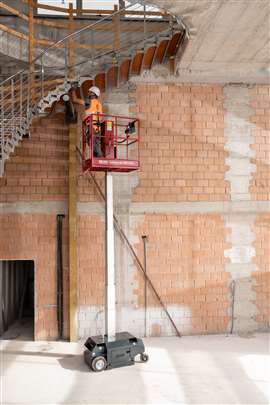 The new Bravi Leonardo HD-4304. (Image: Bravi).
STAY CONNECTED




Receive the information you need when you need it through our world-leading magazines, newsletters and daily briefings.

CONNECT WITH THE TEAM