



Read this article in 中文 Français Deutsch Italiano Português Español
How smarter access equipment is protecting aircraft
Partner Content produced by KHL Content Studio
03 November 2026
Keeping an aircraft safe to fly means getting close enough to inspect, service and repair it. Yet that proximity poses a difficult question: How can you reduce the risk of damage to high-value assets?
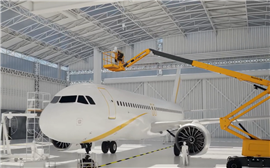 Aircraft maintenance demands close access while minimising the risk of accidental contact
For maintenance teams, the aircraft’s shape and size make reaching the work a challenge in itself. Mobile elevating work platforms (MEWPs) are familiar equipment in aircraft manufacturing and maintenance, with several often working around the same aircraft at once.
From the basket, however, an operator cannot easily judge every clearance between the MEWP and the aircraft. For example, above a wing, the basket floor obscures the operator’s view of the clearance between the basket’s underside and the top of the wing.
 Laurent Muguet, Options and Accessories Marketing Manager at Haulotte
According to Laurent Muguet, Options and Accessories Marketing Manager at Haulotte, contact between a MEWP and an aircraft can lead to substantial financial costs.
Protecting aircraft from accidental contact is the driving force behind Haulotte’s Obstacle Detection Assist (ODA) system, developed in close collaboration with Air France and Airbus. Designed for aviation maintenance environments, ODA automatically stops MEWP movements as the upper part of the equipment approaches an aircraft’s surface.
“The objective was clear: enhance protection against collisions in low-visibility areas while preserving the close access technicians need to perform maintenance tasks efficiently,” explains Ludivine Beraud, Europe Marketing Manager at Haulotte. “The challenge was to strike the right balance between safety and productivity, without creating unnecessary interruptions every time the system detected an obstacle,” she says.
Obstacle detection shaped by the work
“In designing the detection system, we wanted to avoid multiplying sensors across the machine. We wanted a solution that was both efficient and simple,” Beraud says.
“We concentrated on the areas where operators had poor visibility, positioning and angling each sensor to cover as much of those areas as possible.”
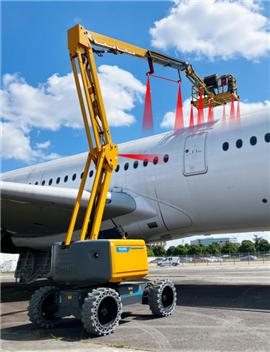 Haulotte’s ODA system detects nearby aircraft surfaces to help operators manage clearances
The ODA system was developed for three models: the STAR 10 vertical mast, the SIGMA16 PRO and HA20E PRO articulated booms. The system is available only as a factory-installed option, with a fixed sensor configuration for each model.
Muguet says the STAR 10’s mast-top ultrasonic sensor detects surfaces above it, whereas on the articulated booms, sensors monitor beneath the basket and around sections of the jib and boom where operator visibility is restricted.
The HA20E PRO combines ten ultrasonic sensors with a laser beneath its boom, while the SIGMA16 PRO uses nine ultrasonic sensors without a laser.
“Proximity detection systems are not new to the industry, but they are often retrofitted by third-party providers,” says Beraud. “ODA is perfectly integrated into the machine design. We offer a seamless user experience and ensure consistent performance and support through a single trusted partner throughout the life of the equipment.”
Controlling MEWP approach
On the HA20E PRO and SIGMA16 PRO, the dedicated human-machine interface (HMI) triggers audible and visual warnings during the approach phase. Movement continues through this zone while the operator assesses the clearance and adjusts the approach.
The HMI beside the upper control box identifies which sensor has detected the obstacle, helping the operator to locate it.
If the operator continues the approach, ODA prevents further movement towards that obstacle when the distance between the sensor and the obstacle becomes critical. The operator can then reposition the MEWP, using movements that do not reduce the clearance further or trigger another sensor.
“When the boom is fully extended with the maximum load in the basket, its inertia is different from when it is retracted with a light load,” Muguet says. “We took those operating conditions into account, including simultaneous movements, to ensure the machine stops at the right time.”
 Ludivine Beraud, Europe Marketing Manager at Haulotte
Taking responsibility for the final approach
“We know operators need to get as close as possible to the aircraft to do their work,” Beraud adds. “The override function allows the operator to approach the aircraft more closely after the machine stops. That closer movement remains the operator’s responsibility.”
On the HA20E PRO and SIGMA16 PRO, authorising a closer approach does not switch off detection across the machine. “If one sensor stops the machine and you override it, another sensor detecting an obstacle will stop the machine again,” Beraud says. “You don’t override the whole system at once. You override step by step.”
Customers can choose to lock the override function, preventing operators from moving closer than an ODA stop permits.
Beraud concludes that the ODA system provides operators with information about hazards and obstacles that may not be easily visible from the platform.
The final approach remains a human responsibility, informed by the technology rather than entrusted to it.
--------
This article was produced by KHL Content Studio, in collaboration with experts from Haulotte
--------
All images courtesy of Haulotte
--------