Read this article in 中文 Français Deutsch Italiano Português Español
Interview: building a new equipment brand in India

25 September 2026
For Meghraj Singh, the decision to move Rentease into equipment manufacturing is the culmination of almost a decade spent putting access equipment to work in the field.
Singh, chairman of the Indian rental specialist, has been involved in the industry for 17 years, while Rentease has been operating for more than 10. That experience, he says, has given the company a different perspective on what customers need from a machine – and what happens to it after it leaves the factory.
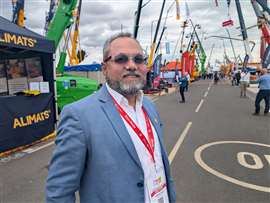 Meghraj Singh spoke with Access Briefing at Vertikal Days, which took place in the UK during September. (Image: KHL).
The result is RE, Rentease’s new equipment brand covering manufacturing, sales, parts, distribution and lifecycle support. Its first product families are RE-Lift, covering access and work at height, and RE-Move, focused on material handling.
“This is not a sudden move for me,” says Meghraj Singh. “We have been working on this since 2017. The exposure I have taken over the last 17 years, and what the company has learned over more than 10 years, gave us a big understanding of the requirements of the customer.”
That field experience is central to the new venture. Rentease provides equipment, rental, service and training, giving it what Singh believes is an advantage over other suppliers.
“Traditional manufacturers keep the global market in mind when they produce the product,” he says. “India is a different market. There is a shortage of skills, and customers need machines which are simple and user-friendly.”
A changing Indian market
The timing also reflects what Meghraj Singh sees as a significant change in India. He estimates the country’s total access-equipment population at around 20,000 to 22,000 machines, with the new-equipment market growing at approximately 16% to 20% a year. Around 3000 new machines were added to the market over the last 12 months.
India has historically been heavily reliant on used equipment, but Singh believes that is changing. Rentease was an early example.
“When rental started, it used to be used machines,” he says. “But in 2017 Rentease was the first company in the country to start the rental business by buying 250 brand-new machines.”
That decision was made when few companies were prepared to invest in new access equipment.
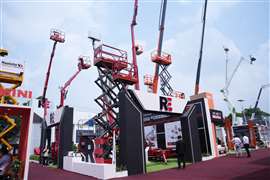 Rentease’s stand at September’s Bauma ConExpo India where the RE products were first presented. (Image: Rentease).
“We were very clear from day one about the destination,” he says. “We could envision the potential of the market.”
Rentease now has around 860-870 access machines in its rental fleet, but manufacturing is set to become the larger part of the business.
The two operations will remain closely connected. Rentease will continue to buy equipment from other manufacturers where RE does not offer the required machine, including from JLG, Genie and Niftylift.
“We will keep buying from the global manufacturers for the part of the fleet which we don’t provide under our manufacturing business,” says Meghraj Singh.
Developing machines in the field
Before launching RE, the company spent approximately 18 months testing machines in the field.
The equipment was exposed to construction and infrastructure projects, but also hospitals, airports, hotels and commercial developments, which Meghraj Singh says provides a different perspective from an end user.
“A rental company can give you proper feedback,” he says. “Five days in a hospital, five days in an airport, five days in a five-star hotel, five days in a commercial complex, and then again 15 months in construction.”
The company’s technical and service teams used that experience to identify where machines could be made simpler, more practical and less expensive to own.
“We didn’t launch a product which we thought we could immediately sell,” Singh says. “We produced a product which we felt could give benefits to the end user.”
One example is the electric boom range. Rather than simply following conventional machine sizes, RE has developed 17m and 29m electric booms to target gaps Meghraj Singh believes exist between established products.
“The customer doesn’t want a 15-metre because the work cannot be done by the 15-metre, but the customer doesn’t need the 20-metre either,” he says. “In between, there is not a single manufacturer coming up with that model.”
The 29m machine follows a similar logic, providing an intermediate option between established 24m machines and larger machines.
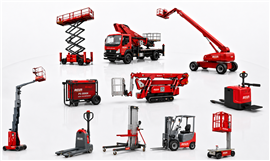 The RE Equipment Range. (Image: Rentease).
The same philosophy has been applied to scissors, with machines ranging from 8m to 16m.
Meghraj Singh argues that some existing equipment is unnecessarily complicated for markets such as India or Africa or Asia and some Middle East applications. Features designed for global markets can add components and maintenance requirements without necessarily providing a benefit to the customer in a particular application.
He points to telematics as one example. While such systems can be valuable in markets where customers expect sophisticated digital monitoring, Singh believes they are not always necessary for every machine and application in India.
RE has instead focused on reducing unnecessary complexity. Singh says this has reduced the cost of maintaining some machines by as much as 70%, contributing to a similar reduction in total cost of ownership.
“It is not about having the least components,” he stresses. “It is about having the proper safety features in place, but removing the things which are not required by the customer.”
The philosophy is therefore simplicity rather than compromise: easier maintenance, lower downtime and lower ownership costs, while retaining the safety systems needed to operate the equipment properly.
A different manufacturing model
RE is also taking a different approach to manufacturing. Meghraj Singh says the company is working with seven or eight global manufacturing partners, with production taking place in India as well as Thailand, China and Taiwan.
The strategy is to design the products in India and select manufacturing partners according to the requirements of each machine.
He provides an analogy. “If you are good at producing a shirt, I will take the shirt only from you,” he explains. “If somebody is very good at trousers, I will take the trousers from them, and the blazers from somebody else.”
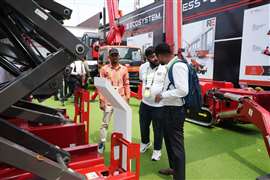 Visitors to the Bauma ConExpo India stand. (Image: Rentease).
“What matters is controlling the product, specifications, quality and ultimate customer experience,” says Meghraj Singh.
Some products are manufactured entirely in India, while others are assembled locally. Truck mounted machines, for example, are mounted on an Indian-manufactured chassis, with RE developing the superstructure. The initial range includes 28m, 36m and 45m machines.
RE-Move, meanwhile, covers material handling. Products include battery-operated and semi-electric pallet trucks, stackers and forklifts with capacities up to three tonnes.
1,000-1,200 machines
Meghraj Singh says RE is planning production of around 1,000 to 1,200 machines in its first year, including approximately 780 access platforms.
That compares with around 467 machines sold by the business in the previous year.
The target reflects Meghraj Singh’s confidence in the market, but he is not relying on price to compete.
India is already highly competitive, particularly with the growth of Chinese manufacturers. Meghraj Singh accepts that RE cannot compete with Chinese companies on either price or payment terms.
“Price we cannot match and the payment terms also we cannot match,” says Meghraj Singh. “So what we are trying to provide is the predefined customer equipment experience.”
He believes that while China’s ability to scale rapidly gives its manufacturers a major advantage, the longer-term requirement is for local service and support.
“China believes in scalability and we in India believe in sustainability,” he says. “The Chinese OEMs can fill the market very fast. But then they need to provide the service and the backup.”
Building a local network
That thinking is behind RE’s distribution strategy, which is based on putting equipment, expertise and support close to the customer.
Five initial distribution locations have been established in Maharashtra – Mumbai, Nagpur, Nashik, Aurangabad and Pune – with each planned to hold a minimum of 50 machines.
The approach is now being put into practice through specialist partnerships. Leopard Equipments and Engineers is covering Pune and Chhatrapati Sambhajinagar with an opening order of 101 machines, while Meghdoot Logistics & Infra is representing RE in Thane with an initial order of 51 machines.
Both partnerships also include plans for RE Experience World Centres, with Meghdoot’s centre planned for Bhiwandi and Leopard’s centres planned for Pune and Chhatrapati Sambhajinagar.
These centres are intended to be more than conventional equipment showrooms. Customers will be able to see and physically experience the machines, understand different applications and technologies, and discuss equipment solutions with specialist teams. They will bring together equipment, applications expertise, sales, rental and technical support in one location.
Meghraj Singh sees the concept as part of a much broader RE ecosystem.
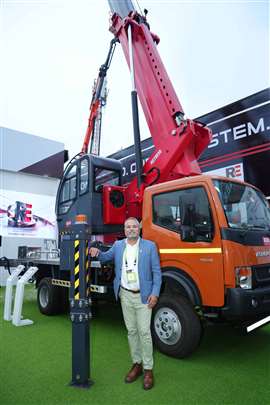 Meghraj Singh with one RE’s new truck mounts. (Image: Rentease).
He describes the centres as a “mini version of Ikea”, but for B2B customers. The idea is that a customer should not have to deal with multiple suppliers to complete a job.
“No one wants to do business with 10 different vendors, they want to make it as simple as possible,” he says. “They just want to deal with one guy.”
A customer who is planning working at height, for example, might need an access platform, welding equipment, tools and a power source. RE’s ambition is to provide those services through one local partner, with the customer able to buy or rent according to the application.
The distribution partners will have the flexibility to sell and, where appropriate, rent equipment. If a partner does not want to invest in rental equipment, RE can work with another partner in the area to provide that service.
This reflects Meghraj Singh’s broader view that rental and ownership should not be competing factors.
“The question should not be whether rental is better than ownership,” he says. “The question is what makes sense for that customer and that application.”
The longer-term objective is to have a service centre roughly every 200km across the country.
“India is such a huge country that it cannot be managed from east or west,” says Meghraj Singh. “There has to be stock in tier-two and tier-three cities.”
He adds: “If you are based in Mumbai and want to serve a guy who is based in Delhi, you cannot be as good as the local guy. We want to be local.”
Availability is a key part of that strategy. Moving a machine between Indian cities can take up to 15 days, Singh says, making it uneconomic for a customer that needs equipment for only three or five days.
“We just want to kill that cost by having the stockist next to you,” he says.
The rental operation will remain part of the network, although Rentease will continue to operate independently and will not become a captive fleet for RE. It will continue to buy machines from manufacturers such as JLG, Genie and Niftylift where those products are the right solution for its customers.
Beyond the first year
RE’s immediate focus is India, with some activity in the UAE and Africa, but Meghraj Singh sees longer-term potential in Europe, the UK and the US.
He points to the growing presence of manufacturers producing in India for export and believes RE could eventually use a manufacturing base in Indian to address overseas markets.
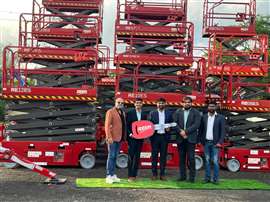 Leopard Equipments and Engineers became one of RE’s first distributors. (Image: RE).
However, he is clear that international expansion will be selective.
“You cannot go blindly to appoint 100 distributors,” he says. “We will select a few of them to start with, and then the rental companies or end users will give us the proper feedback.”
For Meghraj Singh, appointing a distributor is only the beginning. Service engineers must be trained, spare parts and component inventories established, and the infrastructure put in place to support customers.
“Selling the machine is the beginning of the relationship, not the end.”
That is ultimately what connects Rentease’s past with RE’s future. The rental business has provided years of experience in seeing how machines perform in real applications. RE is now using that knowledge to design, manufacture, distribute and support equipment differently.
For Meghraj Singh, the machine itself is only the starting point. “We have to think about the complete lifecycle and what the customer will need for the next 15 years.”
STAY CONNECTED




Receive the information you need when you need it through our world-leading magazines, newsletters and daily briefings.
CONNECT WITH THE TEAM