Read this article in 中文 Français Deutsch Italiano Português Español
IPAF’s Peter Douglas sends safety message

27 April 2026
The CEO of the International Powered Access Federation (IPAF), Peter Douglas, talks to Murray Pollok about MEWP safety and the association’s priorities…and makes a plea on accident reporting.
Peter Douglas and IPAF have proven to be a good match. Since joining the association as CEO in December 2019, membership has grown by more than 600 to 2,000 companies in 83 countries, and in January it issued its three millionth PAL Card, a million of these alone during his tenure.
Douglas, an industry-insider who had a successful multi-year career with Lavendon Access Services and Nationwide Platforms before joining IPAF, doesn’t go in for self-promotion, but speaking to KHL Group at the end of a tiring week at ConExpo-ConAgg, he is clearly proud of what the association is doing.
“We had our best ever net membership growth in 2025, which was really positive”, he says, “Our members are training a lot more people, which is making the industry safer. And I think some of the initiatives over the last few years have made a huge difference, such as the ePAL app launched in 2021.”
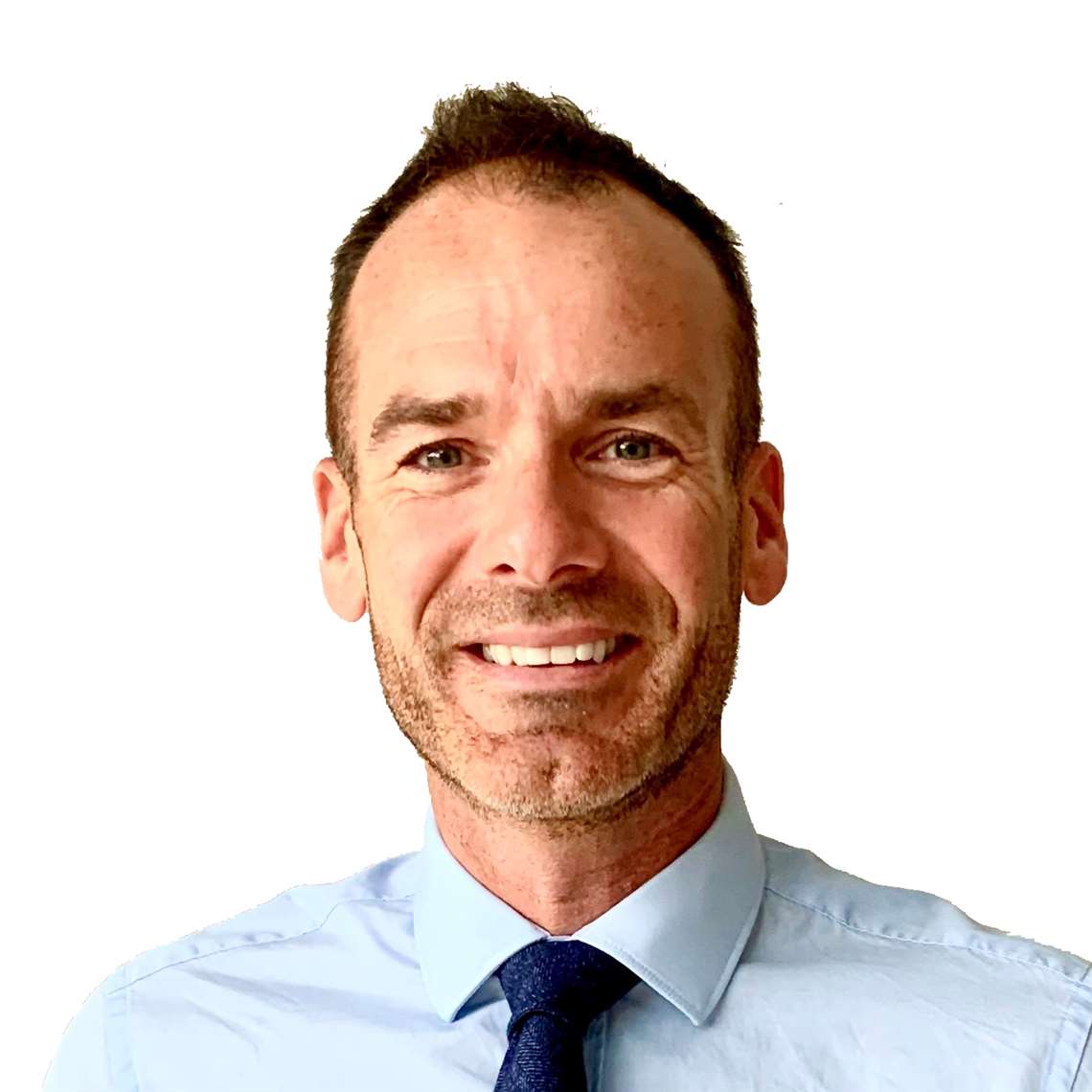
 Peter Douglas, IPAF CEO, pictured at the 2026 ConExpo-Con/Agg show. (Image: KHL Group)
The app was introduced in the UK in 2021 and worldwide in 2022; “And it’s not just a digital way of storing your powered access credentials, your PAL Card and your certificates. It’s also a way of sending safety messages to operators and managers responsible for operators of MEWPs.”
There have been almost 1.2 million downloads of the app since its launch. Of the 230,000 people gaining PAL cards last year, 72% of them went digital. The app includes pre-use checks and also makes it easy for operators to log their operating experience.
Millions of MEWP users
IPAF’s remarkable growth reflects the global rise in the use of aerial platforms, with a rental fleet comprising millions of platforms around the world, which, of course, means multiples of millions of users each year, including many first-time users.
That means the messaging around the safe use of aerial platforms is never a mission accomplished. Douglas, who served on the IPAF board for four years before becoming CEO, is very aware of that.
“Our long-term aspiration is zero accidents in the industry worldwide”, he tells IRN, “And it’s an aspiration that we’ll never achieve. But most of our objectives fit around getting closer to that, improving the current situation worldwide, working with regulators to tighten up legislation, or create legislation in countries where there is none.”
A big part of the growth curve for the association has been its international focus. It may have its origins in the UK – led initially by Paul Adorian and then Tim Whiteman – but IPAF made a definite decision to go global.
Now, although still with its headquarters in Cumbria in the north west of England, it has offices and employees in 14 countries around the world, many serving as bases for regional operations in markets like the Middle East, Asia and Latin America.
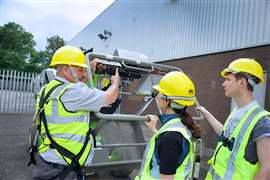 IPAF training centres could train as many as 250,000 operators this year. (Image: IPAF)
Current IPAF priorities
For Douglas, marshaling these resources and setting priorities is a key task. A current focus is on the biggest regions of the world in terms of MEWP usage, North America and China, as well as newer developing markets, such as India and Saudi Arabia.
“Where things are growing very fast, we want to make sure we’re in quite early to ensure that things are done properly”, he says.
It is exhausting work – as a look at Douglas’s travel schedule would tell you – because it requires IPAF to engage with the full supply chain, from regulators and contractors to rental companies and training centres.
“The manufacturers help us, and also the rental companies that we engage with, but it’s really the people that are insisting on doing it properly, the safety people [that we want to reach]. We deal with safety directors and managers in contractors to try and push some of the best practice out there.”
There are different obstacles and opportunities in each market. In Saudi Arabia, for example, IPAF benefits from the presence of European contractors who are used to dealing with MEWPs; “We work closely with those companies, but we also work with the governments and safety authorities to ensure that they understand what we’re doing is best practice.”
China’s rental growth
China is a particular challenge because of the astonishing rate of growth, with a rental fleet of more than one million MEWPs – almost the same as North America – created in little more than a dozen years.
“We’ve been working for the last two to three years with what is the equivalent of the Health and SafetyEexecutive (HSE), the Chinese Ministry of Emergency Management (MEM). Organised by our China team, we’ve had delegations over from China to the UK, and we’ve presented to them”
Douglas thinks, however, that safety in China isn’t quite given the priority it should have; “we’re hoping to have a greater influence by working with our OEM members in the region to try and push some type of regulation.”
He says Chinese rental companies are focused on negotiating a challenging market environment, with a very large fleet and falling rental rates; “The utilisation’s not as high as they need it to be. So, in terms of them investing time and money into improving things from a safety perspective, it’s very difficult at the moment.”
Are its member OEMs doing enough in China? It’s a sensitive question for Douglas, because IPAF has OEMs who are fully supportive and others who could be doing more.
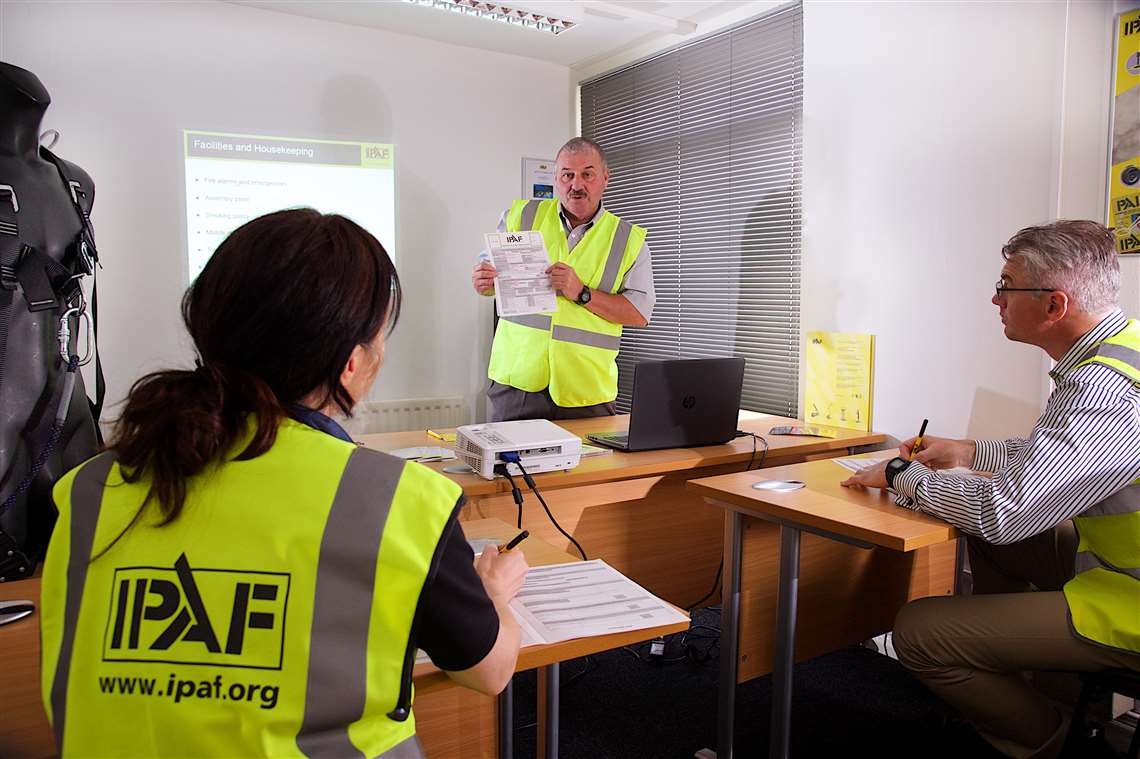
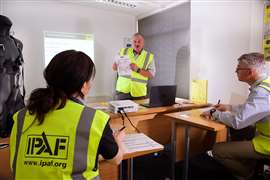 IPAF’s PAL card training required both practical and classroom sessions. (Image: IPAF)
“The OEMs are all supporters of IPAF and we’re very grateful for that”, he says, “Could they be doing more to push for regulation? Yes, more could be done. ”
He says he had good meetings in Las Vegas during ConExpo, but he admits to some frustration at the lack of progress in China; “The message is not getting out there. We’ve produced some simple e-learning tools based on feedback from our members. We’ve made them really accessible, and there has been little traction.”
He makes the point that it’s important for OEMs to do more than have the IPAF logo on their machines; “We’re grateful for their support”, he says again, “but we need them to do more.” That isn’t just in the context of China, but also in markets like India, he adds.
The North American challenge
North America offers a different challenge, with a large number of low-cost training options available to contractors and rental companies. Douglas doesn’t say that all this training does not meet ANSI standards (which are voluntary), but says there are sub-standard courses where you can get a training card in less than three or four hours; “I know people who have done that just to see what it is”, he says, “And you don’t even have to go anywhere, you don’t have to get on a machine.”
IPAF has been offering services tailored to the US market, such as training materials for OEMs – which are required to provide training – to support customers, including both operators and supervisors.
“The model in the US is more of a train-the-trainer approach”, he says, “Because the OEM has the responsibility to offer training, they’ll sell machines to rental companies and they will go in and they’ll train the trainers. The problem is the training is not being updated and it’s not audited.
“That’s where our programme’s a little bit different. It’s updated on a regular basis in line with legislation, in line with new thinking, but it’s also audited. Every training centre is audited annually. We check that they’re doing things properly.
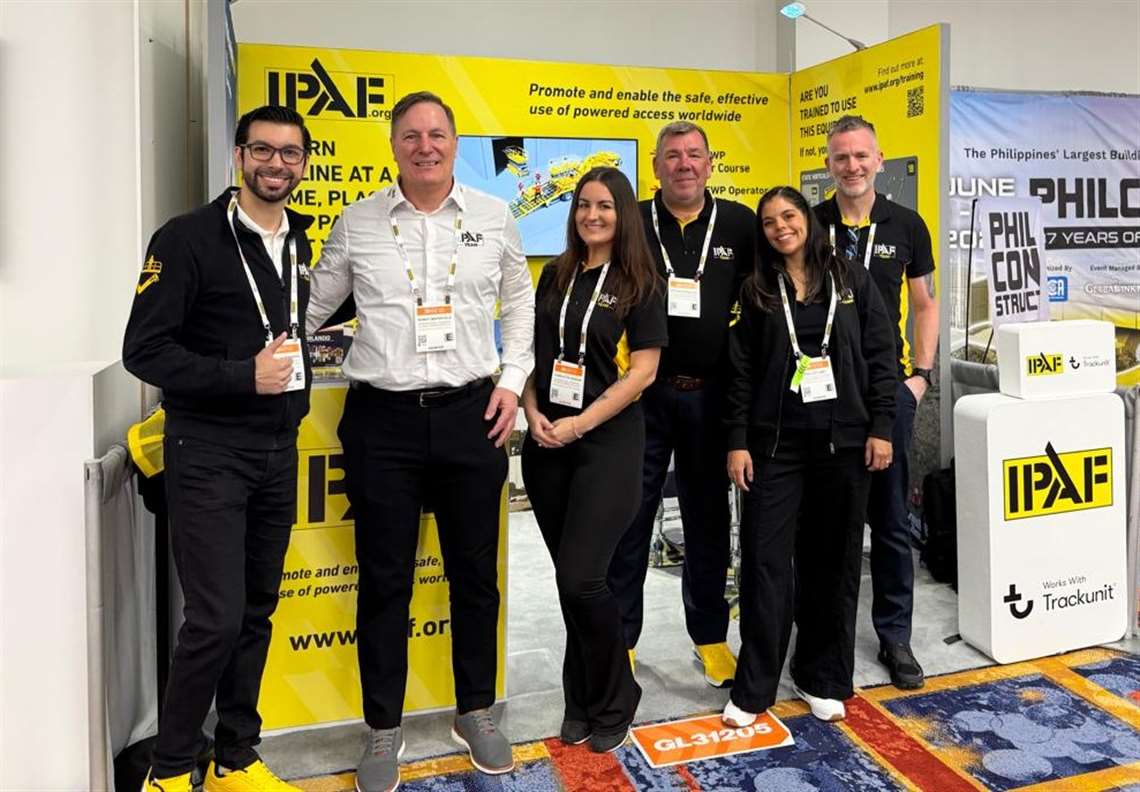
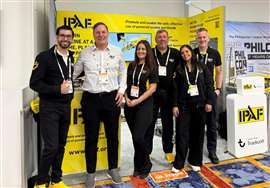 IPAF staff at ConExpo 2026, from left: Diego Bustamante, Randy Marzicola, Charlotte Hudson, Peter Douglas, Ana Solano and Brian Parker. (Image: IPAF)
“So, we’re now offering that as a model, where we can train you or our training centres can. We can give you the material, the world class ISO accredited e-learning – and we can show you how to do your own practical training.”
He says it is starting to make some progress, with new training centres opened in the US last year and net membership growth of 19 in North America last year, the highest number of any region.
“We’re getting there. We’ve put more investment into North America. We’ve got Randy Marzicola, the VP for North America, to support Tony Groat, who’s been here for many years. And we’re really focused on engaging with contractors, with safety professionals, and growing IPAF membership.
“We just want people to be trained. They don’t all have to do IPAF training, as long as they’re doing decent training.”
He says major rental players like United Rentals and Sunbelt Rentals have been supportive. They do their own training, but have consulted with IPAF. United is also selling IPAF’s supervisor training; “That’s an e-learning course, off the shelf. We’ve got a great relationship with their training director. Same with Sunbelt - they sell our MEWPs for Supervisors course, and we work with them really closely.”
Who bears responsibility?
A key question for IPAF is the shared responsibility for safe use of aerial platforms between OEMs, rental companies and contractors/end users. Who bears the greatest responsibility?
“It’s a really difficult one”, says Douglas, “I think the rental companies are focused on getting machines on hire. The training element is, ‘I’m being asked for it and I’ve got to provide it, so I’ll do it’. Don’t get me wrong, some of the people who get involved in training really care and see the importance of it. Others say it’s just a necessary thing they’ve got to do.
“The OEMs, I think, have got to take a bigger share of the responsibility. We need more from the manufacturers to really push safety, particularly in countries such as China and India, as I mentioned earlier.”
Douglas is passionate about safety and is not afraid to be direct. He recounts meetings during ConExpo where he “ranted a bit…I was being passionate. I said, ‘you just need to do more - it’s a leap of faith’. They understand because they invest not knowing that it’s necessarily going to make more money, but because it’s the right thing to do.”
Accident reporting plea
The never-ending nature of IPAF’s mission is in some ways epitomised by its accident reporting efforts, and the creation of a global database of statistics which allows the association to analyse trends and identify safety priorities.
The irony here is that the more successful IPAF is in getting companies to report accidents and near-misses, the bleaker the picture can start to look, although of course it’s the scale of reporting that makes the numbers go up.
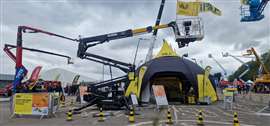 IPAF is present at multiple events around the world every year. Its membership is now close to 2,000 companies. (Image: IPAF)
However, Douglas wants more companies to report; “We’re really disappointed with the accident data from 2025. It was the first year that it reduced.
“This year, we’re really pushing the campaign and encouraging companies to report incidents – and not just serious LTIs [lost time injuries] and fatalities, we want a lot more near miss reporting.”
He says the data gives IPAF a clear picture of what’s happening; “We have an International Safety Committee that analyses that data. The fatal five – as Brian [Brian Parker, IPAF’s Head of Safety & Technical] calls them – the top five reasons for fatalities when using MEWPs are always the same. They just change order.”
These are electrocutions, overturns, entrapment, falls from the platform, and the fifth either being hit by a falling object or mechanical failure.
“That’s where our safety campaigns are predominantly focused”, says Douglas, “This year, our campaign is centred on checking the machine. The quality of the machine obviously has an impact on incidents, so the focus is on carrying out the right checks –not just daily checks, but also pre-delivery inspections, familiarisations, and so on.”
IPAF’s annual Global Safety Report brings all the data together and is the most downloaded resource on its website.
“It takes us months to produce it. Almost like the IPAF Rental Market Reports, you know, there’s a lot of data. It informs everything we do, in terms of improving training, providing areas to focus on, such as the annual safety campaign, Toolbox Talks and Andy Access posters. It feeds into our workload every year.”
Accident reporting can be a tricky area, with some members perceiving that accidents reflect badly on them, even though the data is anonymous; “It’s seen as an admission of failure almost, but it’s really a sign of strength. It says, ‘look, we’ve had this incident, and we’ve put things right in our organisation to make sure it doesn’t happen again.’ I see it as a real sign of strength.”
MEWP safety devices
IPAF also finds itself in the position of being called upon to adjudicate on the various safety-related devices that are developed in the market.
“We don’t endorse any specific safety products”, says Douglas, “The two big ones at the moment are intelligent harness anchorage points and the anti-entrapment solutions for scissor lifts, which contractors are starting to mandate, certainly in the UK.”
He says if the new devices prevent injuries or fatalities, it’s a great thing, but he is concerned that contractors may be mandating things without working through the implications.
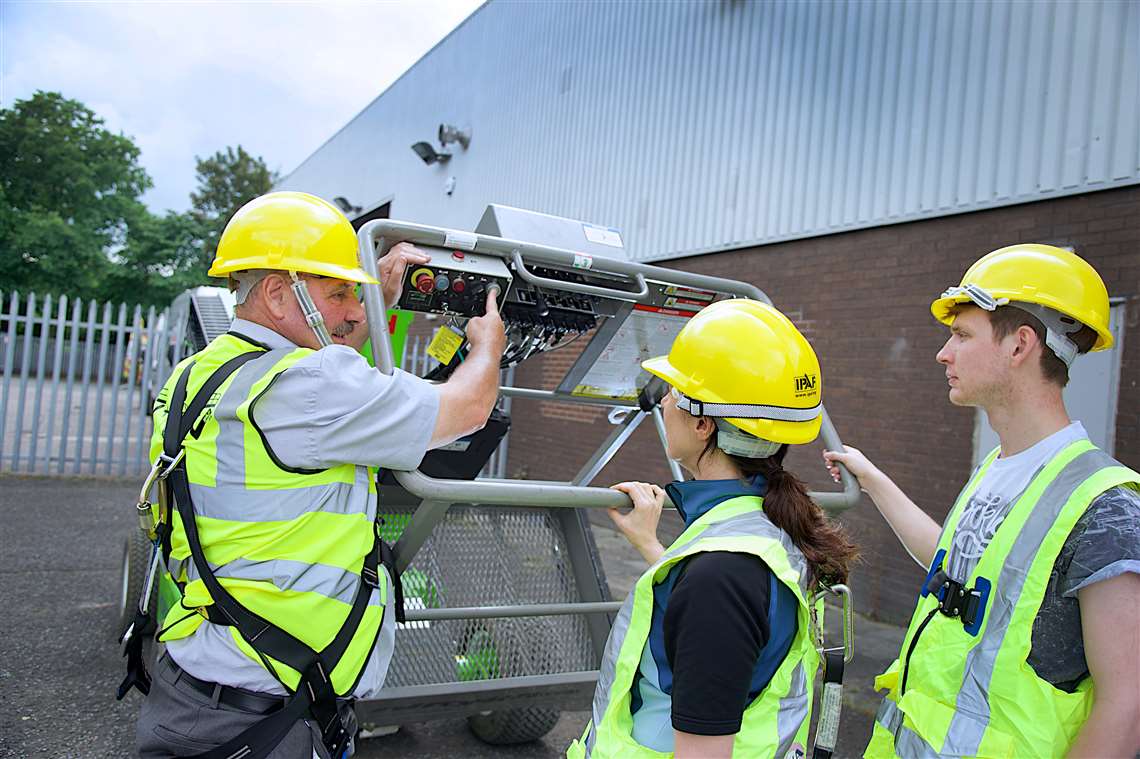
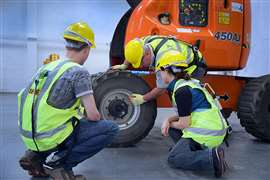 Pre-use inspection being demonstrated to operator trainees. (Image: IPAF)
“We’re trying to work with contractors, because some of the wording around their mandates can be confusing. It’s difficult for rental companies, because they’ve invested in one solution, and some contractors are mandating a specific solution rather than just, ‘it’s got to do this’.”
One effect of this engagement with contractors has been an increase in contractor members, with around 80 companies now part of IPAF, and the vast majority of these are outside the UK.
An IPAF ‘community’
One feature of any successful industry association is the ability to create a community feel, and IPAF has done that, partly through its numerous events around the world, including the International Awards for Powered Access (IAPAs) that it runs annually with KHL Group.
“The powered access industry is unique”, says Douglas, “It’s one of the only industries where you’ve got competitors coming into a room as part of a committee and genuinely leaving differences at the door. They are not there for their own business gain, but to genuinely try and improve things.
“And it’s all elements of the supply chain, not just rental companies. We’ve got manufacturers, contractors, component supplies, training companies - we’ve got the complete ecosystem. It’s a bit of a magical formula, I think.”
Of course, it means a pretty intense working life for Douglas himself. Can he maintain his intensity? “I do enjoy it. The travelling gets a little bit much sometimes, but it also gives me energy”, he says, “It’s amazing seeing how engaged our members are at events around the world.
“The real lifeblood of what we do, in its basic form, is making people safer. The heroes are our members who deliver the training, the instructors. We’re aiming to train 250,000 people this year, which would be a fantastic achievement for the entire industry.
“When I go to our events around the world, I always love to talk to those trainers, because they’re the ones that believe in it, and they’re going to pass that belief and that enthusiasm to the trainees.”
STAY CONNECTED




Receive the information you need when you need it through our world-leading magazines, newsletters and daily briefings.
CONNECT WITH THE TEAM