Read this article in 中文 Français Deutsch Italiano Português Español
Truck mounts: balancing the envelope

26 October 2026
Truck mounted platforms continue to develop across a broad range of applications, from urban maintenance and rental fleets to high-reach work and specialist access. At the same time, design is being shaped by the limitations of vehicle weight, the need to work in restricted spaces, increasingly sophisticated safety and control systems and the importance of standardisation of product lines.
There have been a few significant developments in the truck mount market in recent months. For example, Italy-based CTE’s expansion programme is being influenced in part by its integration into the Socage Group, following Socage’s acquisition of the Italian manufacturer in August 2025. The company says the integration is already producing results, with design and technical teams sharing components and engineering know-how.
For truck mounted platforms, the first results include the expansion of the range with the Automatic series of 3.5 tonne truck mounts. CTE has also expanded its wider aerial platform offering with the TRCS spider range.
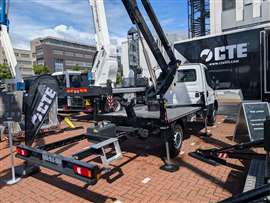 CTE launched a new colour scheme at APEX in June, following its acquisition by Socage. The Italian company’s traditional RAL 5017 blue has made way for Black combined with Grey Aluminium. (Image: CTE).
The 27m and 24m working height B27 and MP24 are the next truck mounted models to benefit from the group’s shared expertise, with both receiving a fresh design and upgraded technology. CTE says the development of the MP24 will be substantial enough to give it a new identity and name.
The latest vehicle mounted products presented by CTE include the 15 VTJ, mounted on an Iveco Daily Van and presented at Vertikal Days. The closed van provides a practical solution for maintenance crews that need to carry tools and materials securely while working in urban areas.
Service is another important part of the company’s development strategy, with CTE saying customers are increasingly looking for support throughout the working life of a machine.
“A truck mount is a working tool, and every hour of downtime is a cost,” says the company.
In this respect, CTE’s Platform Service provide owners and rental companies with spare parts, qualified technical assistance and remote support, including VRA, or Augmented Reality Video Call.
Connectivity is also becoming part of the machine itself through telematics and diagnostics. Advanced control systems are also being developed to provide more intuitive operation and increased safety, adds the company.
“We see continued strong demand for compact 3.5 tonne machines that can be driven with a standard license, as well as growing interest in van mounted platforms for urban and maintenance work.”
Approaching limited access
Socage’s latest truck mounted aerial platform is the Forste 20A Speed, launched at APEX 2026 in Maastricht. It has a maximum outreach of 12m and a total length of 6.4m, combining a compact vehicle footprint with a working envelope suitable for urban environments and locations with limited access.
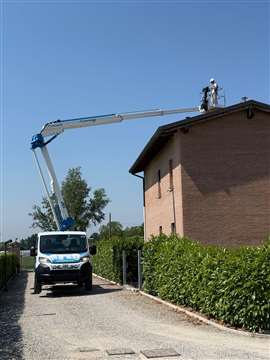 Socage’s latest launch is the Forste 20A Speed. (Image: Socage).
The 20A Speed is mounted on a Stellantis chassis, with Fiat Ducato, Peugeot Boxer, Citroën Jumper and Opel Movano configurations available. Socage says the choice also gives customers access to an extensive European vehicle service network, with the aim of improving spare-parts availability and reducing intervention times.
Socage describes the model as the starting point for a new generation of platforms. Its development strategy includes optimisation of components, improved efficiency, simpler everyday operation and reduced downtime.
“Customers are increasingly looking for machines that combine performance and compactness with ease of use, reliability and fast, effective after-sales support,” says Socage. “These requirements are particularly important in urban applications, where equipment must operate in congested and hard-to-access locations.”
Technology is also being used to make operation safer and simpler, with intelligent systems helping operators manage machines more intuitively and automate more complex operations.
Cross-range developments
Multitel’s latest truck mounted developments include the MJE710, MZ300 and MXE130, covering different applications and vehicle classes.
Introduced in 2025 and launched at Bauma, the MJE710 represents the upper end of the range, with a maximum working height of 70.6m and outreach of up to 37m. It is mounted on a 32 tonne chassis and has an overall vehicle length of approximately 12m. Its automatic variable stabilisation system allows the working area to adapt to the available space.
The MZ300, presented at Vertikal Days, has a working height of 29.8m. Its maximum horizontal outreach is 15.8m with 80kg in the basket and 11.8m with the maximum 280kg basket capacity. Automatic stabilisation, Home Function and radio remote control are standard.
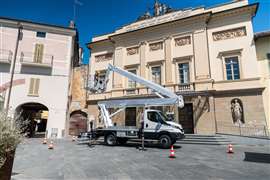 Multitel’s MZ300 in a city centre setting. (Image: Multitel).
The MXE130 is mounted on an Isuzu N60 4x4 and provides a 13.5m working height and 6.4m outreach with the full 250kg basket capacity, together with 380° turret rotation and ±50° basket rotation.
Roberto Marangoni, global marketing and international sales director at Multitel Group, says the three products illustrate the company’s development direction.
“We are continuing to work on achieving more performance within increasingly efficient dimensions and weight classes.”
Working height remains important, but Marangoni says development is increasingly concerned with the complete usability of the machine, including outreach, basket capacity at outreach, compactness, stabilisation footprint, positioning and transport efficiency.
“Customers are increasingly asking for machines that can do more while occupying less space.”
This is particularly evident in rental, where one machine increasingly needs to cover a broad range of applications. Multitel is also developing new models in the up to 3.5 tonne segment, while at the higher end it is transferring technology developed for the MJE710 to other models, including its new boom concept and hydraulic architecture.
Electronics and connectivity are another development area. Multitel’s EVE – Evolved Electronics and Multitel Telemetry are proprietary systems developed specifically for its machines.
“Overall, I believe the industry is moving towards truck mounted platforms that are more compact, more intelligent and easier to use, while delivering increasingly high levels of performance.”
A standardised approach
Versalift’s latest generation is the V-Range, a standardised family of seven models in the 3.5 tonne class covering working heights from 17m to 27m.
The V-170, V-200, VA-200-F, V-230, V-270, V-250-F and VA-240 share the same core XPC control system, hydraulic architecture and electrical architecture.
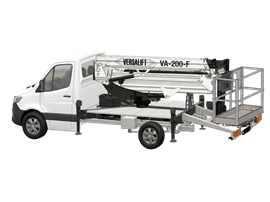
The V-200 is the established foundation of the range, with more than 100 units built and delivered. The V-170 entered production in 2025, while the articulated VA-200-F was launched at APEX in June. The next major milestone is the V-270, which at 27m will become the tallest model in the range.
Rather than developing the models as a series of individual machines, Versalift has created a common technical platform. “The XPC system, controls, hydraulic response and overall operating philosophy are standardised. An operator familiar with one V-Range machine can therefore transfer that knowledge to another model with minimal additional familiarisation.
“For fleet owners, this standardisation has practical benefits. Technicians can work across the range without having to learn completely different systems, while common components simplify spare-parts management and maintenance.”
Connectivity is standard through RTC – Real Time Connect, giving fleet managers and service teams remote access to machine information, operating hours, GPS data, maintenance alerts and fault information.
Versalift says customers are increasingly considering availability, ease of operation, maintenance, training and total cost of ownership alongside working height and outreach.
“For us, the future of truck mounted access platforms is about combining performance with simplicity, connectivity and fleet-wide standardisation,” adds the company.
Combining performance
Palfinger’s latest major European introduction is its new TEC range, comprising the PT 19 TJ, PT 22 TJ, PT 25 TJ and PT 28 T. Officially launched at Bauma 2025, the range covers working heights from 19m to 28m and has since moved into serial production and customer delivery, with the first publicly announced PT 25 TJ customer units handed over in June 2026.
Development has focused on performance, ease of use and lifecycle efficiency. The range combines high outreach and basket capacity with compact vehicle configurations, precise controls, automatic setup functions and weight-optimised designs. Modularity and improved serviceability are intended to reduce maintenance requirements and increase machine availability.
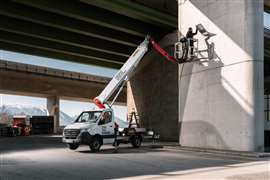 The first PT 25 TJ units were delivered to customers in June. (Image: Palfinger).
Optional electric platform operation allows work with the truck engine switched off, while Palfinger Connected provides connectivity and remote diagnostics for fleet management, service planning and uptime.
The company says aerial work platforms form an important part of its long-term growth plans under Strategy 2030, with development focusing on portfolio modernisation, greater modularity and standardisation, digitalisation, electrification and further optimisation of weight, payload and chassis integration.
“Our general direction is clear: we want to offer high-performance, increasingly modular and globally competitive solutions, while continuing to adapt products to the specific requirements of individual regions and applications.”
Palfinger identifies machine availability as critical, particularly for rental companies, alongside precise and intuitive controls, stability, lateral outreach, basket capacity, simple setup, vehicle payload and serviceability.
Weight optimisation remains a major issue, particularly in the European 3.5 tonne class where safety equipment, batteries, tools and other equipment compete for limited vehicle payload. Electrification is also becoming more application-driven, with different roles for electric platform operation, electric chassis and conventional powertrains according to the duty cycle.
Sharing technology platforms
Tadano’s latest truck mounted development is the Scorpion 18, alongside the Snake 24, Scorpion 16 and Scorpion 23.
The four models share a technology platform focused on safety, ease of use and operational precision. Electrohydraulic controls provide smooth and precise operation, while hydraulic stabilisation is standard and automatic stabilisation is available as an option.
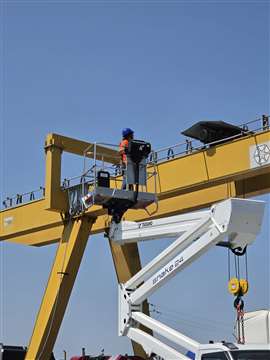 Tadano’s Sanke 24 on an Aveco chassis. (Image: Tadano).
Anti-collision, Homing and Memory functions are standard, while remote connectivity supports machine management and diagnostics. Platform capacities range from 250kg to 300kg depending on model.
Rocco Stipo, R&D manager, Tadano Oil & Steel Series, says development is concentrated on three main areas: improving performance by optimising machine movements and operating speeds; developing more advanced human-machine interfaces combining intuitive operation with real-time machine information; and increasing standardisation across the range.
“Rental companies typically prioritise ease of use, quick and straightforward maintenance, low total cost of ownership and remote management and diagnostic tools that allow them to monitor machine condition, minimise downtime and reduce the need for on-site interventions.”
End users, Stipo says, tend to place greater emphasis on performance, advanced functionality and the ability to configure or customise machines for specific applications.
Regulation is another influence on development, including the new Machinery Regulation and relevant industry standards, together with emissions requirements and truck safety systems.
Structural development is also being used to balance increased capability with vehicle weight. High-yield-strength materials, thinner sections and optimised geometries can reduce structural weight, offset increases in truck chassis weight and support higher working heights.
Stipo identifies a clear trend in the 3.5-tonne sector: “One clear trend is the move towards greater working heights on platforms mounted on 3.5 tonne trucks, with average working heights increasingly moving beyond the traditional 20m level.”
Key objectives
Klubb has introduced three products during 2026, covering van, pick-up and chassis-mounted applications.
Launched at the beginning of the year, the KL17P provides a 17.3m working height on a 3.5 tonne van and can be driven on a standard category B licence. It can carry up to three people in the cab as well as equipment in the rear, while a screen in the basket assists the operator in controlling the platform.
The KA14 followed in July. The 14.3m articulated platform is mounted on a 3.5 tonne pick-up and is also drivable on a category B licence, with its off-road capability aimed particularly at work in the countryside.
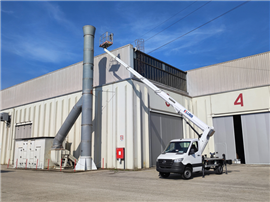 KLUBB PT 280_1: Klubb will launch the PT280 at the end of 2026. (Image: Klubb).
At the upper end, Klubb plans to launch the PT280 at the end of 2026. It combines a 28m working height with a 3.5 tonne chassis and is aimed particularly at rental companies looking to offer greater working height while retaining category B licence operation.
Further development will extend the range downwards with the KL15P cutaway vehicle with jib and KL13 with fixed arm. A 25m version derived from the PT280 is also planned, featuring a telescopic boom and jib.
Klubb says customer requirements are increasingly centred on safety, intuitive controls and shorter operator training, alongside efficient use of labour and vehicle space. Productivity and total cost of ownership are also influencing design, while demand for electric and hybrid solutions is being driven by requirements for silent, engine-off and lower-emission operation.
The company plans to focus increasingly on telemaintenance and data management. Remote diagnostics are intended to reduce downtime through real-time troubleshooting, while machine data can support fleet efficiency and maintenance. Its platforms are already compatible with electric vehicles and trucks.
|
An Indian Journey India’s relatively young truck mounted platform market is developing its own manufacturing base, with Gemini Power Hydraulics expanding its locally designed LEVO range. Its latest launch is the Levo 24, a 24m truck mounted platform and the third model designed and manufactured in-house by Gemini, following the LEVO 11 and LEVO 14. A key feature is its hinged telescopic design. Aahan Sethi, director of Gemini Power Hydraulics, says the concept was developed in response to the debate in India over articulated and telescopic machines, combining the compactness and working flexibility of an articulated platform with the outreach potential of a telescopic machine. A jib and basket rotation provide additional positioning flexibility around structures and obstacles. Like the Levo11 and Levo 14, the Levo 24 uses Strenx performance steel, with Gemini also a member of SSAB’s My Inner Strenx programme. The company’s next phase will focus primarily on low to mid-range machines between 11m and 20m, including products designed specifically for pick-ups and 3.5 tonne chassis. This reflects Gemini’s ambitions beyond its domestic market, with the company looking to design around vehicle classes already established internationally rather than subsequently adapting products developed solely for India. 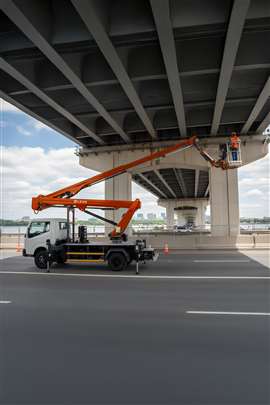 Gemini’s latest and tallest launch, the Levo 14. (Image: Gemini). |
STAY CONNECTED




Receive the information you need when you need it through our world-leading magazines, newsletters and daily briefings.

CONNECT WITH THE TEAM